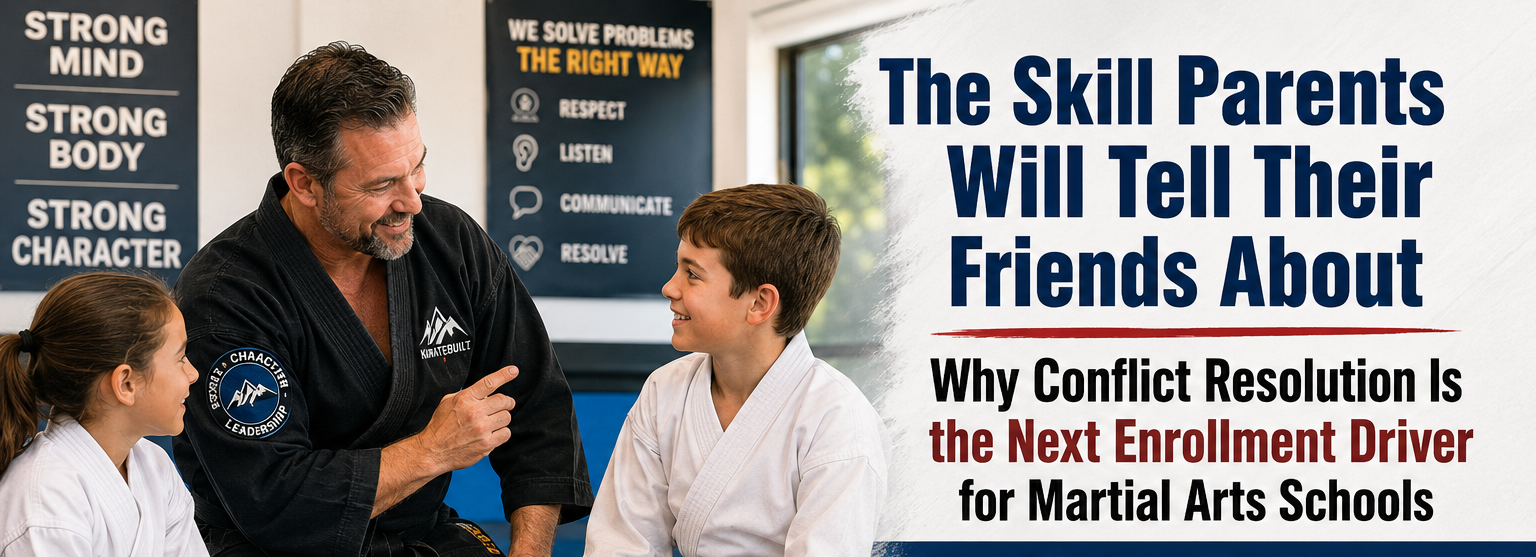
The Skill Parents Will Tell Their Friends About — Why Conflict Resolution Is the Next Enrollment Driver for Martial Arts Schools
June 23, 2026 by
Jason
By Dr. Greg Moody, Ph.D., Chief Master Instructor
Most martial arts schools in the country market the same three things: self-defense, fitness, and discipline. Those words bring parents through the door. They are not the words that keep families enrolled, and they are not the words that drive word-of-mouth.
After more than 30 years of clinical psychotherapy practice and martial arts instruction, the pattern is clear. Parents enroll for the headline benefit. Parents stay — and tell their friends — for the skill that comes home with the child. Conflict resolution is one of the most parent-noticed life skills in any curriculum. Done right, it becomes the reason families stay and refer.
The schools winning the next decade are the schools that build conflict resolution as a teaching pillar — a curriculum students apply OUTSIDE the school. At recess. In the classroom. With siblings. In friend groups. Online. The framework lives in the school. The application lives everywhere else. The parent who watches her kid use the language at the dinner table within two weeks of starting is the parent who tells four other parents about your school within a month.
Three concepts make this curriculum work — and almost no school teaches them cleanly.
Concept one: the Three-Category Map. Most parents — and most teachers — conflate four completely different problems. Abuse is usually adult-on-child or severe. Bullying is peer abuse with three components together: intent to harm, repetition, imbalance of power. Violence is physical danger of injury. Conflict is peer disagreement without all three bullying components. Each of the four requires a fundamentally different response, and using the wrong tool makes the situation worse every time. Teaching a 7-year-old to sort the three categories — and use the right language for each — changes how she handles every social situation she encounters for the rest of her life. It also changes how her parent handles the situations the parent hears about.
Concept two: the Four P’s. Once a situation has been correctly identified as conflict (not bullying, not violence, not abuse), the next question is which kind of conflict. Preference (we want different things). Perception (we misunderstood each other). Pressure (something else is loading the situation). Process (the way we are fighting IS the fight). Each P has its own resolution path. Most adults default to treating every conflict as a Preference problem and try to mediate a compromise. That fails about 75% of the time for the conflicts that are actually Perception, Pressure, or Process. Teach kids to name the P out loud and the resolution rate climbs dramatically — and parents notice within weeks.
Concept three: the Switch. When two people are stuck in a conflict trap — escalating, withdrawing, going silent, going loud — both are running the same broken pattern. The trap was built by both of them. The exit only needs one. Once one person shifts from reaction to response, the trap collapses. The other usually follows within minutes. Kids learn this idea in two or three classes. They start using it at home within two weeks. The first time a parent watches her 7-year-old say to her 5-year-old “I think we’re both in a Loud trap, can we talk in 20 minutes,” the parent stops eating, looks at the spouse, and texts her best friend. That parent enrolls more families for your school in the next 90 days than any ad campaign you have ever run.
The curriculum also requires teaching the boundary — when conflict resolution will NOT work. Abuse, bullying, and violence each require different responses. Teaching kids (and parents) when to use conflict tools versus when to escalate is what makes your school the trusted resource for the local elementary school, the school counselor, the PTA, and the pediatrician. The schools that own this position do not chase enrollment. Enrollment shows up at their door.
On Wednesday, July 22, 2026, at noon Eastern, I am hosting a live event with Grand Master Stephen Oliver. Kids Conflict Resolution 2026: The Life Skill Parents Will Tell Their Friends About. Attendees walk out with the complete curriculum framework, instructor scripts, parent handouts (the word-of-mouth engine), family communication scripts, outreach materials for local elementary schools and PTAs, and the marketing pieces to claim the conflict resolution position in your community. The materials are only available to attendees, and the event is live — not a recording.
If you are a martial arts school owner or instructor and you want enrollment growth driven by parents who fall in love with your curriculum and tell their friends — instead of paid acquisition — this is the framework that does it. Register at [REGISTRATION URL].
The schools that win the next decade will not be the ones with the biggest ad budgets. They will be the ones whose curriculum comes home with the child, gets noticed at the dinner table, and gets talked about at school pickup. After July 22, you will be one of them.
About the Author: Dr. Greg Moody holds a Ph.D. from Arizona State University and is an 8th Degree Black Belt and Chief Master Instructor. He owns and operates KarateBuilt Martial Arts, runs psychotherapy practices through Integrated Mental Health Associates in Scottsdale, AZ, and serves as V.P. Development at Rev Marketing 2U, Inc.