To maintain communication with the Artemis II crew across 252,760 miles of space, NASA operated a global network of ground stations on multiple continents, working in coordinated shifts around the clock, handling voice communication, data transmission, and telemetry simultaneously. When the spacecraft passed behind the moon and all signal was temporarily lost, Mission Control had systems in place specifically designed to manage that window and reestablish contact the moment the trajectory allowed it. There was no gap in the protocol. There was no moment when the crew reached out and no one was there to respond.
Now consider what happens at your school on a Tuesday evening at 7:15. You are on the mat teaching your intermediate class. Your phone is in the office. A parent who just finished dinner has opened Google, searched for a kids martial arts school, found your listing, and is calling to ask about enrollment. The call goes to voicemail. You will see it at 8:45 when the last class ends, and by then you are tired, the kids need to be picked up from the babysitter, and the call feels like something to handle in the morning.
Wednesday morning arrives. You call back. The parent, who spent Tuesday evening calling three schools, has already scheduled a trial class at the one that answered. Not because that school was better. Because that school was there.
An adult looking for self-defense classes searches at 9:30 on a Saturday morning, when you are running your kids program. A potential new adult student from your website inquiry form submits at 11:15pm on a Sunday. A parent of a teenager interested in competition training calls during your lunch break on Friday. Each of these people is motivated at the moment they reach out. Each of them becomes significantly less motivated with every hour that passes without a response. And each of them represents a student your school never got the chance to welcome.
This is not a staffing problem. It is a systems problem. And in 2026, it has a solution that was not available even two years ago at anything approaching an accessible price point for a small martial arts school.
What AI Voice Agents Actually Are in 2026
The term AI voice agent covers a wide spectrum of technology, and it is worth being precise about what the current generation of tools can actually do, because the gap between what school owners imagine and what is genuinely available right now is significant in both directions. Some owners assume AI voice agents are the robotic IVR systems they have been hanging up on for twenty years. Others assume they are science fiction not yet ready for real-world deployment. Neither assumption is accurate.
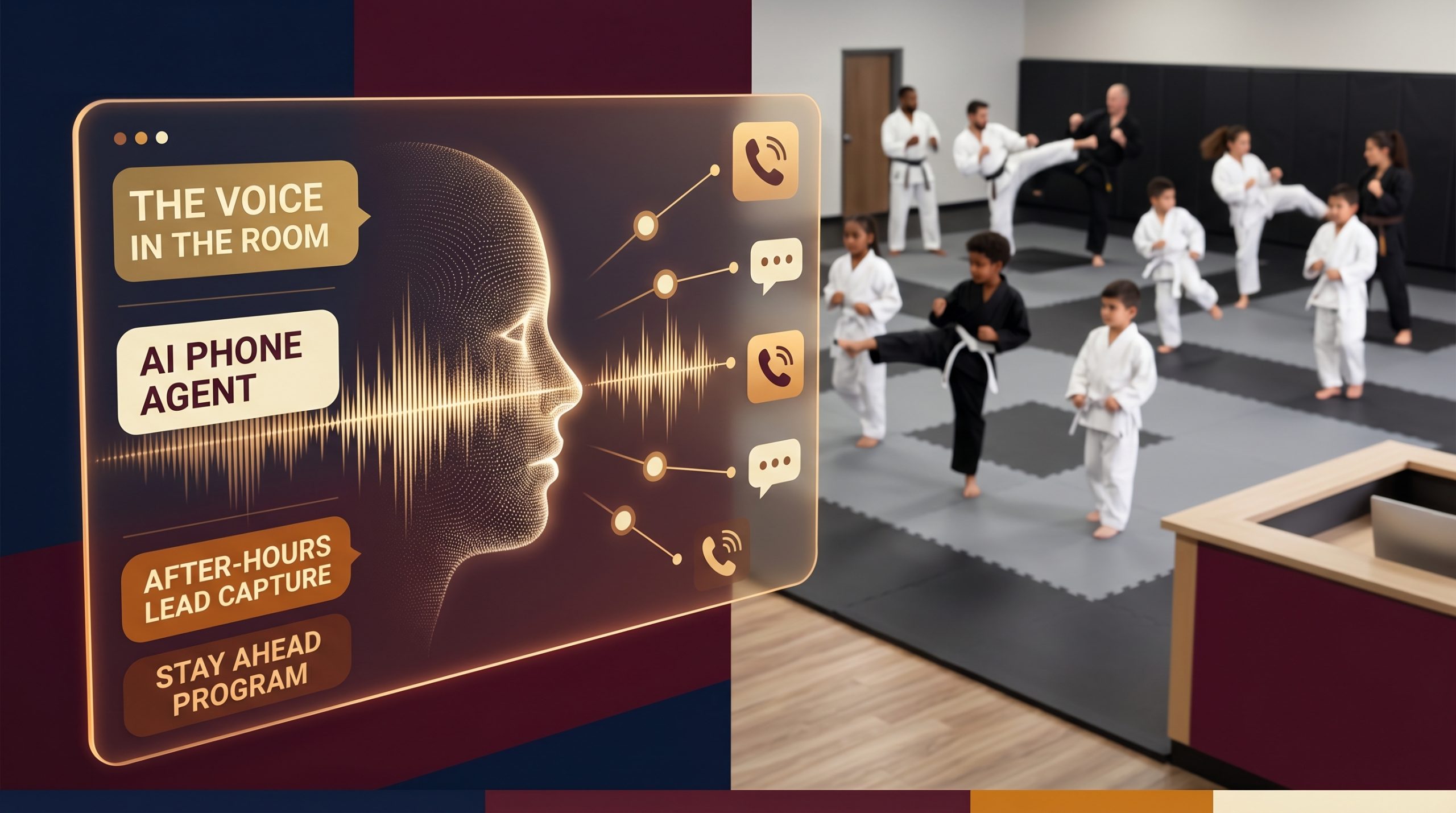
Current AI voice agents, built on large language models and trained for conversational interaction, are capable of conducting natural, warm, fluid phone conversations that the majority of callers cannot distinguish from a human interaction within the first sixty seconds. They can answer questions about your programs, your schedule, your pricing structure, your instructor credentials, and your trial class process. They can ask qualifying questions to understand what the caller is looking for, whether it is a program for a child of a specific age, adult self-defense training, fitness-focused martial arts, or competitive training. They can handle objections, express genuine enthusiasm, and guide the conversation toward the most appropriate next step, whether that is scheduling a trial class, sending a follow-up text with more information, or flagging the call for a personal follow-up from a staff member during business hours.
Critically, they can do all of this at 11pm on a Sunday, at 6am on a Saturday, during your 4:30 kids class on a weekday, and at every other moment when a motivated person reaches out and no human being is available to answer. The coverage is complete. The response time is immediate. The consistency is perfect, because a system does not have bad days, does not forget to ask the qualifying questions, and does not sound tired at the end of a long teaching day.
“When our team first started tracking after-hours inquiry data for schools on our platform, the numbers were striking. A significant portion of all inbound inquiries, both calls and form submissions, were arriving outside of traditional business hours. These were real people with real motivation who were reaching a wall of silence at exactly the moment they were most ready to take action. AI voice agents remove that wall entirely.”
Tracy Lee Thomas | Founder, Rev Marketing & Go2 Karate
The After-Hours Opportunity Most Schools Cannot See
Research on consumer search behavior for local services consistently shows that a significant portion of searches for children’s activities, fitness programs, and personal development services happen outside of traditional business hours. The reasons are straightforward: parents search when their children are in bed. Adults searching for self-defense or fitness training search when their workday is over. Teenagers interested in martial arts search when their school day ends. These windows, the evenings, the early mornings, the weekends, overlap almost perfectly with the times when most martial arts school owners are either teaching, managing class transitions, or genuinely unavailable.
Google’s research on local search behavior shows that a substantial share of calls to local businesses from mobile search happen between 6pm and 9pm on weekdays, and that mobile searches for local services are disproportionately concentrated on evenings and weekends relative to the hours when businesses are staffed. The person who finds your school at 8pm on a Wednesday and calls at 8:05pm is not an unusual case. They are your most common case. And if your school’s response to that call is a voicemail box, the research on lead response time tells you with precision what happens next.
Studies tracking callback rates on voicemail messages left with local service businesses find that fewer than 20 percent of callers who reach voicemail leave a message at all. The remaining 80 percent hang up and call the next option on their list. Of those who do leave a message, a substantial portion will have made contact with another business before their message is returned if the return call takes longer than two hours. The voicemail box is not a safety net. It is a filter that removes 80 percent of your after-hours opportunity before you ever know it existed.
What the Conversation Should Sound Like
One of the most common concerns school owners raise about AI voice agents is the question of warmth and authenticity. Will it feel robotic? Will people know they are talking to an AI? Will it damage the school’s reputation for genuine human connection? These are legitimate concerns and they deserve a direct answer.
The current generation of AI voice agents, when properly configured and trained on the specific voice, values, and personality of a school, does not sound robotic in the sense that older automated phone systems did. The language is natural. The pacing is conversational. The responses adapt in real time to what the caller says rather than following a rigid script. A parent who calls asking about a program for her 8-year-old daughter who has been struggling with confidence should receive a response that acknowledges that specific concern, speaks to how the school’s program addresses it, and invites her to experience it firsthand. That conversation should feel warm because it has been built to be warm, with the school’s voice and philosophy at the center of every interaction.
The parallel to the Artemis II communications infrastructure is more than metaphorical. NASA’s ground stations did not communicate with the crew using a generic, impersonal protocol. Every exchange was specific to the mission, to the moment, and to the people involved. An AI voice agent built correctly for your school should operate on the same principle: every conversation specific to the person calling, the program they are asking about, and the next step that makes the most sense for them.
For Families Inquiring About Youth Programs
A parent calling about a program for their child almost always has an underlying concern driving the inquiry beyond the surface question about schedule or price. They want to know whether the school is safe. Whether the instructors are patient with children who are nervous or slow to warm up. Whether the culture is competitive in a way that might intimidate a younger child or supportive in a way that would encourage one. An AI voice agent trained on these concerns can address them directly, using the specific language and values of your school, in a way that makes the parent feel heard and confident rather than processed.
For Adults Seeking Training for Themselves
An adult calling about self-defense training, fitness-focused martial arts, or returning to a practice after years away has a different set of concerns. They may feel self-conscious about their fitness level. They may be uncertain whether they are too old, too out of shape, or too far removed from any athletic activity to be successful. They need reassurance that is honest and specific, not generic enthusiasm. An AI voice agent configured for your adult programs can address these concerns with the same warmth and specificity, ask the right qualifying questions, and guide the conversation toward a trial experience that removes the uncertainty of showing up somewhere new.
The standard to hold any AI voice agent to: Would a prospective student who had this conversation feel genuinely welcomed, accurately informed, and clearly directed toward a next step that makes sense for them? If the answer is yes, the technology is working. If the answer is no, the configuration needs refinement. The tool is only as good as the intention and specificity built into it.
The Phone Number Is Not Enough Anymore
Here is a question worth sitting with for a moment. What does your website actually offer someone who wants to reach your school right now? For the majority of martial arts schools, the honest answer is a phone number. Sometimes a form. Rarely anything more. And that answer, which may have been adequate five years ago, is now one of the most significant invisible barriers between your school and the people who are trying to find it.
Think about who is reaching out to your school on any given day and where they are when they do it. A parent who just received a call from their child’s teacher about behavior at school, sitting in a parking lot during their lunch break, wanting help with courtesy, self-discipline, and respect and knowing in their gut that a martial arts school is exactly what their child needs. They are not going to call you from a parking lot and wait on hold or leave a voicemail. They might send a text if the option exists. They might use a chatbot to get quick answers about your schedule. They might fill out a form if it is short enough to complete between bites of a sandwich. A parent at home after the kids are in bed, researching options on their phone, who wants to book a trial class right now without speaking to anyone. An adult man researching a self-defense class for his wife who works late and wants to have something arranged before he mentions it to her. A teenager whose friend started training and who wants to find out about the competitive program at 10pm on a school night. None of these people are in the same situation. None of them are best served by a phone number and a business hours voicemail.
Research on consumer communication preferences shows that the channel through which someone chooses to reach a business is not arbitrary. It reflects their situation, their comfort level, and their expectations about the interaction. Studies from Salesforce and Twilio consistently show that more than 60 percent of consumers now prefer to begin a business interaction through a channel other than a phone call, with text messaging and live chat both outranking phone for initial contact in most demographics under 50. For the martial arts market, which serves everyone from young children’s parents to working adults to seniors exploring fitness options, the range of preferred communication channels is particularly wide. A single-channel approach, whether that is a phone number only or a form only, guarantees that a significant portion of your potential audience cannot interact with your school in the way that works for them.
There is another issue hiding in this conversation that our team surfaces regularly in audits, and it connects directly to something covered earlier in this series. Many schools have a phone number on their website that does not match the number on their Google Business Profile. This is not a minor inconsistency. It is an entity signal failure that tells Google and AI systems that these two sources are not confidently describing the same business, suppressing your school’s authority in exactly the search environments where you most need it. If you read that and felt a moment of uncertainty about whether your numbers match, that is the first thing to check before anything else in this article is acted upon.
What a Complete Communication Stack Looks Like
A complete communication infrastructure for a martial arts school in 2026 does not mean more complexity for the owner. It means more access points for the person reaching out, all feeding into a single unified system that manages every conversation consistently. That stack includes an AI-powered chatbot on your website that can answer common questions, describe your programs for both youth and adult students, and either book a trial class directly or collect contact information for follow-up. It includes a text messaging capability that allows someone to initiate a conversation by text from your website or from your Google Business Profile listing. It includes a form that is short enough to complete in under two minutes and triggers an immediate automated follow-up sequence the moment it is submitted. And it includes an AI voice agent that handles inbound calls when no one is available, conducts a warm and capable conversation, and routes the outcome appropriately.
All of these channels should be connected. A person who starts a conversation in the chatbot and then calls the next day should be recognized as the same person. A text inquiry and a form submission from the same number should feed into the same follow-up sequence without duplication. The unified system behind these channels is what transforms a collection of contact options into a genuine communication infrastructure, one that serves the person wherever they are, in whatever mode works for them, at whatever hour they reach out.
Where is your school right now? School has a phone number only, no chatbot, no text, no AI. School has a phone number and a basic contact form. School has a phone number, a form, and a chatbot with limited capability. School has a unified communication stack: AI voice, chatbot, text, form, and automated follow-up all connected in one system. Each step represents a meaningful increase in the percentage of motivated people your school successfully captures and engages. Most schools are still on step one or two in a market that increasingly expects step four.
The Consistency Problem No School Owner Talks About
Our team has reviewed the transcripts of hundreds of inquiry interactions between martial arts schools and prospective students and members. The pattern that emerges from that review is not flattering, and it is important to say that with full respect for the people involved, because the issue is not talent or dedication. It is consistency, and consistency is the one thing that human beings operating under real-world conditions cannot reliably deliver across every interaction, every day, without exception.
The best front desk person your school has ever had is excellent some of the time. On a Thursday morning after a good night’s sleep with no competing demands, they are warm, thorough, and perfectly on-script. On a Monday afternoon when another call is ringing on the second line, a parent just walked in with a question, and their own child called from school because they forgot their lunch, that same person is doing their best under real pressure. The interaction is not the same. The follow-up questions get skipped. The scheduling conversation is rushed. The prospective student or parent on the other end of that call receives a meaningfully different experience than the Thursday morning version delivered, and there is no way to know in advance which version they are going to get.
This is not a criticism. It is a description of how human beings work under the kind of multitasking, high-interruption conditions that define a typical martial arts school operating day. The research on cognitive load and performance degradation is extensive and consistent: complex task performance declines measurably under interruption, and the verbal interactions most affected are the ones that require sustained focus, genuine listening, and structured guidance through a conversation with a clear goal. That is precisely the description of a new student inquiry call handled well.
What our team has observed, across the hundreds of transcripts we have reviewed, is that when AI handles those conversations, the consistency is not comparable to a good human day. It is comparable to a perfect human day, every single time, with no degradation under pressure, no interruption vulnerability, no missed qualifying questions, and no variation in warmth or thoroughness based on what else is happening in the school at that moment. The AI does not get distracted. It does not rush. It does not forget to ask about the prospective student’s specific goals, whether that is building confidence in a child, getting fit as an adult, learning self-defense, or returning to training after years away. It asks every time. It listens every time. It guides toward the next step every time.
We want to be clear about something important. This is not an argument that AI should replace human beings in your school’s communication. Human relationships are the foundation of what a martial arts school is, and nothing about that changes. What we are saying is that the consistency and reliability of AI in handling the initial inquiry conversation, the critical first contact that determines whether a motivated person becomes a trial class booking or disappears to a competitor, is measurably superior to what any human being can deliver consistently across every interaction under real operating conditions. That is not an opinion. It is what the recorded calls show, repeatedly, across schools of every size and every staffing level.
The Four Types of Schools and How They Use AI Voice
Our team has observed four distinct approaches to AI voice in the schools we work with, and the outcomes are as different as the approaches.
The first group refuses AI voice entirely, believing their team handles calls well enough. They are partially right: their team handles the calls they answer. The calls during class, the after-hours calls, the calls during the lunch rush, these disappear without record. This school is measuring its phone performance against the fraction of calls it knows about and calling that fraction representative.
The second group implements AI voice for after-hours only, with human staff taking all calls during business hours. This is better than nothing, but it creates a two-tier experience where the quality and consistency of the first contact depends entirely on which shift the prospective student calls during. The after-hours callers get consistent, structured, goal-oriented conversations. The daytime callers get whatever version of the staff member happens to be available. The inconsistency remains, just in a different configuration.
The third group implements AI voice comprehensively but then constrains it so tightly with specific scripts and required phrases that the conversation loses the natural, adaptive quality that makes AI voice effective. These schools have the right infrastructure but have built walls around it that prevent it from performing at its actual capability. They are holding the AI to a standard of rigidity that makes it sound more like the old robotic IVR systems than the natural conversational tool it is designed to be. The result is a system that checks the boxes but does not produce the results, and an owner who concludes that AI voice does not work when the actual conclusion should be that rigid scripting does not work.
The fourth group implements AI voice, tests it thoroughly at launch, reviews it every 90 days, and treats it as an adaptive system rather than a fixed one. They make refinements based on what the conversation data shows. They add new program information when offerings change. They adjust the tone when feedback suggests it. They understand that the AI is not a tool you configure once and forget, it is a system you tend, like any high-performing part of your operation. These schools see the results that make other school owners assume the numbers cannot be real. They are real. They are the product of implementing a powerful tool with the same intentionality and ongoing attention that any powerful tool deserves.
“When our team reviews transcripts comparing a school’s human-handled inquiries to their AI-handled ones, the difference in consistency is not subtle. The AI asks the right questions every time. It handles the conversation with warmth every time. It guides toward the booking every time. The best human interaction we have seen is better than any AI interaction. But the average human interaction, measured across hundreds of transcripts under real operating conditions, is not. Consistency at scale is what changes enrollment numbers. And consistency at scale is what AI delivers.”
Tracy Lee Thomas | Founder, Rev Marketing & Go2 Karate
The Speed of What Is Coming
There is one more thing that belongs in this conversation, and it is the thing that our team finds most difficult to communicate to school owners who are still weighing whether to engage with AI at all. The pace of change in AI is not comparable to any previous technology cycle that martial arts school owners have navigated. It is not like websites, which improved gradually over years. It is not like social media, which grew steadily over a decade. What is happening in AI right now is closer in pace to the launch of the Artemis II rocket than to any gradual evolution: explosive, accelerating, and building momentum with every passing month in ways that make the capability available today look limited compared to what will be available in twelve months.
The AI voice agent that handles your after-hours calls competently today will handle them with significantly greater nuance, personalization, and capability next year. The AI systems that generate local search recommendations today will be more deeply integrated into every platform people use to find businesses within eighteen months. The gap between schools that have built AI infrastructure and those that have not will be wider in a year than it is today, and wider still the year after that, because AI compounds in capability the same way a launched rocket compounds in velocity. The schools that are building with AI now are not just ahead of the schools that are not. They are on a trajectory that the schools starting later will find increasingly difficult to match.
This is not a reason for anxiety. It is a reason for clarity. The question is not whether to engage with AI in your school’s communication and marketing infrastructure. That question has already been answered by the direction the technology is moving. The question is when to begin, and the answer to that question has a measurable cost that grows with every month of delay. Whatever the AI does for your school today, it will do better tomorrow. Whatever your school captures through AI-powered inquiry handling this month, it would have captured less of last month, and will capture more of next month if you start now and continue refining.
The schools that understand this are not waiting for the technology to feel comfortable or proven. They are building with it now and refining as it improves, arriving at each new capability level with an existing foundation that makes the upgrade seamless rather than a catching-up exercise. That is what it means to Stay Ahead. Not to predict every development before it arrives. To be in motion in the right direction when it does.
Miles across which NASA maintained continuous communication during Artemis II. Your school loses contact when class starts.
(NASA, April 2026)
Of callers who reach a voicemail box hang up without leaving a message and immediately move to the next option
(Ruby Receptionists, 2024)
Of mobile searches for local service businesses occur outside of traditional business hours, concentrated in evenings and weekends
(Google Consumer Insights)
Maximum response time at which AI voice agents and automated follow-up systems engage inbound inquiries, regardless of time of day
(Rev Connect 360 platform data)
The mathematics of the after-hours gap are straightforward once they are visible. If your school receives inquiries during hours when no one can respond, and 80 percent of those inquirers do not leave a message and move on immediately, the question is simply how many inquiries arrive during those hours and what they would have been worth over a student’s lifetime at your school. The answer, calculated with your own inquiry volume, your own conversion rate, your own tuition rate, and your own average student retention, produces a number that makes the investment in AI voice infrastructure look entirely different than it does before the calculation is done.
What Happens When the School Is Always There
A school we work with in the Great Plains region had strong daytime inquiry handling. When the front desk was staffed and the owner was available, their conversion rate from inquiry to trial class was excellent. The problem, which they had not quantified until our team ran the audit, was that 44 percent of their inbound inquiries were arriving outside of staffed hours. Of those, fewer than 15 percent were leaving voicemail messages. The rest were disappearing into a gap the school did not know existed at the scale it did.
The owner’s initial estimate of their monthly inquiry volume was significantly lower than the actual volume revealed by their call tracking data, because they were only counting the inquiries they knew about. The ones that called during class, hit voicemail, and moved on were invisible to them. They had been measuring their marketing performance against a fraction of their actual lead flow for months.
Of inbound inquiries arriving outside staffed hours, mostly going unanswered
Of inbound inquiries receiving a response within 90 seconds after AI voice agent deployment
Increase in monthly trial class bookings within 60 days, driven almost entirely by previously lost after-hours inquiries
We deployed an AI voice agent configured specifically for their school, trained on their program offerings for both children and adult students, their pricing philosophy, their instructor backgrounds, their culture and values, and their trial class process. The agent handled after-hours calls with a warm introduction, qualified the caller’s interest and specific needs, answered the most common questions about programs and schedule, and either booked a trial class directly into the school’s calendar or collected contact information and a callback preference for a personal follow-up during business hours.
Within 60 days, monthly trial class bookings had increased by 38 percent. The increase came almost entirely from inquiries that had previously been lost to after-hours voicemail. The school’s marketing had not changed. Their visibility had not changed. The only change was that when someone reached out at 8pm on a Tuesday during the intermediate class, there was a voice in the room. Multiply that 38 percent booking increase by your trial-to-enrollment conversion rate, your tuition, and your average student lifetime, and the picture of what after-hours silence has been costing your school becomes very clear.
Building the Communication Infrastructure Your School Deserves
NASA did not maintain communication across 252,000 miles with a single ground station and a hope that someone would be available when the crew called. They built a global network of ground stations, coordinated across time zones, designed specifically to ensure that no matter where the spacecraft was in its trajectory, there was always a receiving station in position to maintain contact. The coverage was engineered. The reliability was designed in from the beginning.
Your school’s communication infrastructure deserves the same intentional design. Not a voicemail box and a hope that motivated people will wait for a callback. A system that ensures every inquiry, regardless of when it arrives, is met with an immediate, warm, capable response that moves the conversation forward. One that captures every opportunity that is currently disappearing into the gap between when people reach out and when someone is available to respond.
The technology to do this exists right now. It is not experimental. It is not cost-prohibitive for a school of any size. And it does not require you to be available at all hours or to hire staff to cover every possible inquiry window. It requires a decision to build the infrastructure that your school’s growth deserves, and a partner who understands both the technology and the specific needs of a martial arts school well enough to configure it correctly.
“The schools that will look back on 2026 as a turning point are the ones that stopped losing 80 percent of their after-hours inquiries to silence and started meeting every person who reached out with the same warmth and capability they would have received if they had walked through the front door at noon on a Wednesday. The technology makes that possible. The decision to use it is what makes it real.”
Tracy Lee Thomas | Founder, Rev Marketing & Go2 Karate
The Mission Does Not Pause When the Class Starts
The Artemis II crew did not stop receiving support from Mission Control because it was after business hours in Houston. The mission continued around the clock because the stakes demanded it and the infrastructure was built to provide it. Ground stations on multiple continents ensured that no matter what time it was, no matter what the crew needed, there was always a voice in the room.
Your school’s mission is to find the people who need what you offer and to give them the chance to experience what you do. That mission does not pause when your 4:30 class starts. It does not take the weekend off. It does not stop because you are tired after a long teaching day. The people searching for you at 8pm on a Tuesday and 9:30am on a Saturday are just as real, just as motivated, and just as deserving of a response as the person who walks through your door at noon.
Building the voice infrastructure that meets them at the moment they reach out is not a luxury for well-resourced schools. It is a standard that every school can achieve and that every motivated inquirer deserves. Our Strategic Development Team is ready to show you exactly what that infrastructure looks like for a school like yours and how quickly it can be in place.
Schedule your complimentary Strategic Development call at Go2Karate.com. [INSERT BOOKING LINK]
Sources & Citations
- NASA – Artemis II Communications Infrastructure: Global ground station network, 252,760-mile communication range, April 2026 (nasa.gov)
- Ruby Receptionists – Small Business Call Handling Study: Voicemail abandonment rates and caller behavior when reaching voicemail (rubyreceptionists.com)
- Google Consumer Insights – Local Business Search Behavior by Time of Day: Evening and weekend concentration of mobile local service searches (think.google.com)
- InsideSales.com – Lead Response Time and Conversion: Voicemail callback rates and competitor contact probability by response window (insidesales.com)
- Rev Connect 360 Platform Data – AI Voice Agent Response Time and After-Hours Inquiry Capture Benchmarks
- Bland AI / Retell AI / Vapi – AI Voice Agent Capability Benchmarks for Local Service Business Applications, 2026
- HubSpot – After-Hours Lead Response and Conversion Rate Impact for Small Service Businesses (hubspot.com)
- Salesforce – Customer Expectation Research: Response time expectations for local business inquiries across age demographics (salesforce.com)