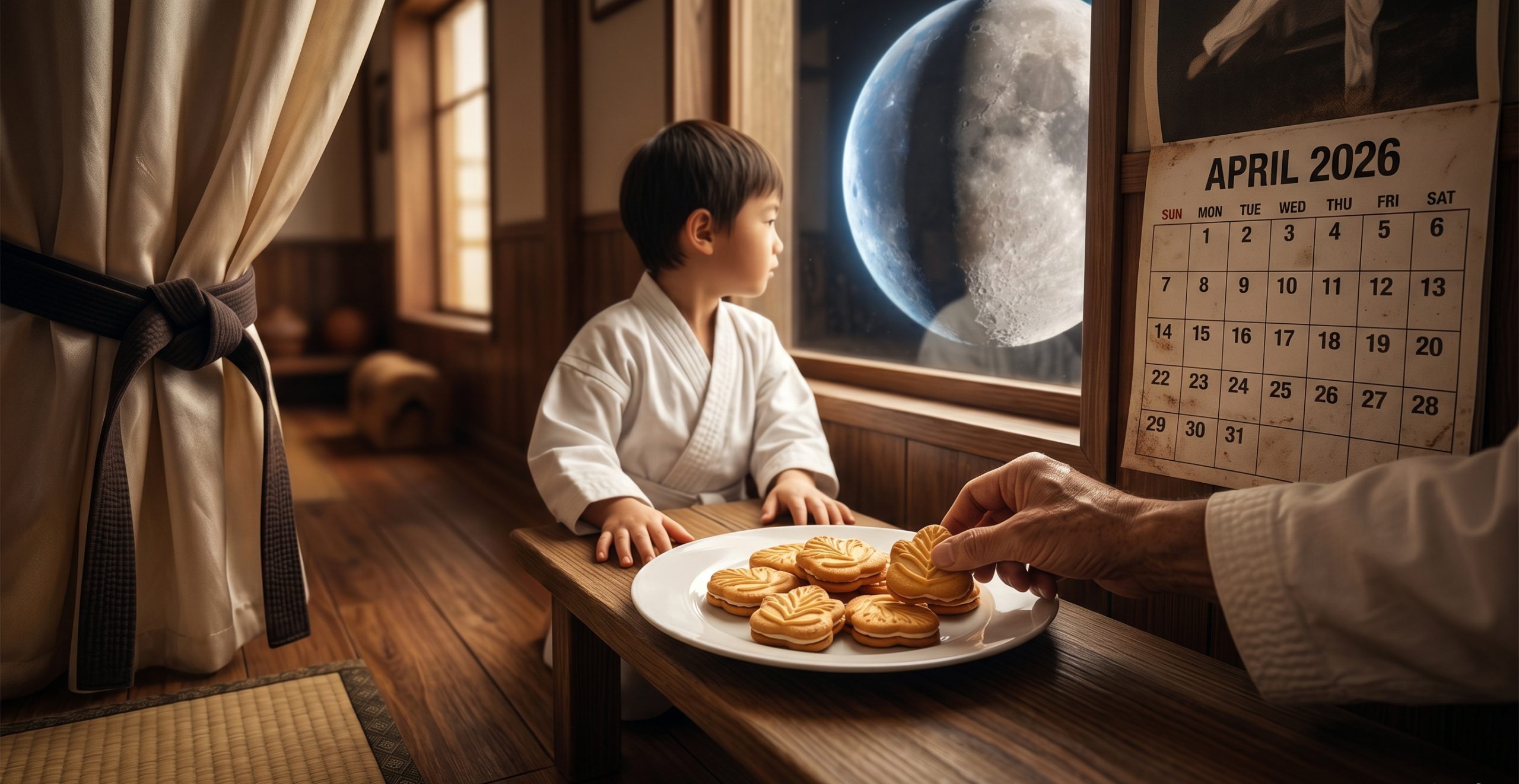
On April 6, 2026, as the Artemis II spacecraft swung around the far side of the moon and all communication with Earth went dark, the four astronauts aboard did something that nobody planned, nobody scripted, and nobody could have predicted would become one of the most shared stories of the entire mission. Canadian Space Agency astronaut Jeremy Hansen produced a package of maple cream cookies, a small piece of home carried across 252,000 miles of space, and the crew shared them together in the silence behind the moon.
When contact was reestablished and Commander Reid Wiseman described the moment, people around the world responded in a way that no amount of official NASA communication had produced. Not because the cookies were remarkable. Because the humanity was. Four of the most accomplished people on the planet, farther from home than any humans in history, marking an extraordinary moment the same way any group of friends might: with a shared snack and the simple acknowledgment that this, right here, was something worth celebrating.
That story was not in the mission plan. It was not a marketing decision. It was a genuine human moment that happened to occur during one of the most watched events of 2026, captured and shared because it was real. And it traveled precisely because it was real, because it showed people something about the crew that the official mission communications could never quite communicate: that these were human beings, not just astronauts, and that what they were doing mattered to them in ways that went beyond the mission objectives.
Your martial arts school has moments like this happening every week. The child who broke their board for the first time after six months of trying and burst into tears of joy. The adult student who came in for self-defense training after a frightening experience and six months later walks with a confidence that everyone around them notices. The teenager who walked through your door shy and withdrawn and is now leading warm-ups for the junior class. The senior student who almost quit during a difficult testing cycle and, with their instructor’s support, earned a rank they did not believe was possible. These are not marketing materials. They are the actual substance of what your school does. And they are the most powerful thing you have to show the world, if you choose to show it.
What Authentic Culture Content Actually Does
There is a version of social media marketing that most martial arts schools have tried and found unsatisfying: promotional posts about class schedules, generic motivational quotes over stock photos of people punching bags, announcements about belt promotions that list names without telling any story. This content is not wrong. But it is forgettable, because it says nothing that any other school could not say with equal authority. It is the martial arts equivalent of an official NASA press release: accurate, professional, and easy to scroll past.
Authentic culture content works on an entirely different principle. It does not announce what your school offers. It shows what your school is. And the difference between those two things is the difference between content that people acknowledge and content that people share, save, comment on, and show to someone else because it made them feel something.
Research on social content engagement consistently shows that content featuring real people in genuine moments outperforms polished promotional content across every meaningful metric: reach, engagement rate, comment volume, and save rate. Meta’s own research on content performance shows that video content featuring authentic moments generates three to five times the engagement of equivalent promotional content. This is not a social media trend. It is a reflection of how human beings process trust and make decisions about the people and organizations they choose to align themselves with.
When a parent searching for a martial arts school for their child sees a video of a real child at your school breaking their first board and crying with pride while their parent cheers from the edge of the mat, they are not watching an advertisement. They are watching a preview of what their child’s life could look like. That preview does something that no promotional post about your class schedule or your instructor credentials can do: it makes them feel the outcome before they have ever set foot inside your school. And feeling the outcome before they arrive is one of the most powerful drivers of the decision to reach out.
“The schools that are consistently generating organic inquiries from social content are not the ones spending the most on production. They are the ones capturing the real moments. A parent crying at a belt ceremony filmed on a phone is more powerful than any professionally produced ad, because the parent watching it at home knows instantly that what they are seeing is true. Truth travels in ways that promotion never does.”
Tracy Lee Thomas | Founder, Rev Marketing & Go2 Karate
The Moments That Are Already Happening in Your School
One of the most consistent observations our team makes when working with schools that are underperforming on social content is that the content they need is not missing. It is happening every day and going uncaptured. The school is sitting on a library of authentic, emotionally resonant moments that would outperform anything a marketing agency could produce, and those moments are evaporating unrecorded because nobody has made capturing them a deliberate part of the school’s culture.
The moments worth capturing are not limited to belt ceremonies and tournament victories, though those are absolutely worth documenting. They include the quieter moments that often carry the most emotional weight for the people watching.
The Transformation Moments
A child who came to your school unable to make eye contact with adults and now greets every black belt instructor by name with a confident handshake. An adult who started training because they felt unsafe and is now teaching a women’s self-defense workshop for their colleagues. A teenager who was failing three classes at school and is now on the honor roll because the discipline and focus they developed on the mat transferred directly into their academic life. These transformations are the reason your school exists. They are also, when shared with permission and genuine care, the content that makes other people in similar situations look at your school and think: that could be my child. That could be me.
The Community Moments
The group hug after a difficult class where everyone pushed further than they thought they could. The senior student who stayed an extra hour to help a junior student prepare for testing. The instructor who remembered that a student was nervous about a school presentation and asked about it at the start of class. The way your school handles a student’s first day, and their hundredth day, and the day they earn the rank they have been working toward for years. These moments reveal the culture of your school in ways that no about page or list of credentials ever will.
The Human Moments
The instructor who shares what martial arts has meant in their own life, not as a professional credential but as a personal truth. The parent who writes about what changed in their family when their child started training. The adult student who describes what it meant to walk into a school as a beginner at 52 and be welcomed without judgment. These stories are marketing only incidentally. Their primary purpose is truth. And truth, in the current content environment where authenticity is increasingly rare and increasingly valued, is the most shareable thing your school possesses.
How Culture Content Connects to AI Visibility
The connection between authentic culture content and AI search visibility is not intuitive but it is real and increasingly important. Earlier articles in this series covered the signals that AI systems use to determine which businesses to recommend: entity consistency, structured data, review volume and specificity, and authoritative directory presence. Authentic content plays into this ecosystem in two direct ways that most school owners have not yet considered.
First, detailed, specific review content, which is one of the strongest signals for AI recommendation algorithms, is significantly more likely to be generated by students and families who have been moved by a genuine experience and have seen that experience reflected in the school’s public communications. A school that regularly shares real transformation stories, real community moments, and real human content creates an environment in which the people who are part of that community feel seen and are more likely to articulate their experience in specific terms when they leave a review. The depth of review content that AI systems favor is a downstream product of a culture that is already being shared authentically.
Second, content featuring real people, real moments, and real outcomes generates social engagement, and social engagement generates the kind of distributed mentions, shares, and community conversations that add to a school’s overall web presence. While social signals are not direct ranking factors in traditional search, the broader web footprint that authentic content builds contributes to the entity authority that AI systems use to assess a business’s credibility and community relevance. A school that exists only on its own website and its Google Business Profile is a thinner entity, from an AI system’s perspective, than a school that exists in community conversations, in shared content, in parent group discussions, and in the authentic social fabric of its local community.
The content audit question: Look at your school’s social media from the past 90 days. How much of it shows real people having real experiences at your school? How much of it is promotional announcements, generic motivational content, or stock imagery? The ratio between those two categories is a reasonable approximation of the ratio between the content that is building your community and the content that is disappearing into the feed. The maple cookie moment was not planned. But a school that has built a culture of capturing genuine moments is the school where that kind of content happens regularly, because the culture creates the moments and the moments create the content.
What the Research Shows About Authentic Content
Higher engagement rate for authentic video content featuring real people vs. equivalent promotional content
(Meta Business Research, 2024)
Of consumers say they trust user-generated and authentic content more than traditional advertising when making purchase decisions
(Nielsen, 2024)
Of people say user-generated content highly impacts their purchasing decisions, with video content of real experiences rated most influential
(Stackla Consumer Content Report)
Higher conversion rate from authentic student testimonial content vs. brand-produced promotional content for local service businesses
(BrightLocal, 2024)
The data on authentic content performance is not a recent discovery. It has been consistent across platforms and industries for years. What has changed is the threshold. As AI-generated content has proliferated and the volume of polished, produced content has increased dramatically, authenticity has become rarer and therefore more valuable. A genuine moment, captured simply and shared with real context, stands out in a content environment that has never been more saturated with content that looks good but feels like nothing. Your school’s genuine moments are not competing with professional production budgets. They are competing against an absence of authenticity that makes them, when they appear, impossible to ignore.
When the Cookies Became the Campaign
A school we work with in the Upper Midwest had been running standard promotional social media for two years: class schedule announcements, tournament results, belt promotion lists, and occasional motivational quotes. Their follower count was modest, their engagement rate was low, and their social media was generating almost no inbound inquiries. The owner described it as something they maintained out of obligation rather than genuine belief that it was working.
Our team reviewed their content history and identified two posts that had broken dramatically from their typical performance pattern. One was an unplanned photo taken by a parent: a 7-year-old girl, completely exhausted, sitting on the mat after earning her orange belt, leaning against the school owner with the biggest smile anyone had ever seen on her face. The second was a short paragraph the owner had written after a particularly meaningful class, describing what it felt like to watch a student who had been told repeatedly they were not athletic discover, for the first time, that their body was capable of something they were proud of. Both posts had generated ten times the normal engagement. Both had prompted comments from parents who had never interacted with the account before, saying things like “this is exactly why we want our daughter to be here.”
Social-driven inquiries per month before shifting to authentic culture content strategy
Social-driven inquiries per month within 90 days of consistent authentic content
School created a waitlist for their youth program within 6 months, a first in 8 years of operation
We built a simple culture content practice around what was already happening in the school. The owner began keeping a notes app on their phone to capture small moments during the week: the student who surprised themselves, the parent who said something that needed to be heard by other parents, the quiet milestone that deserved acknowledgment. A parent volunteer with a phone and a genuine interest in the community began documenting belt ceremonies, notable class moments, and the informal interactions that revealed the school’s character most clearly. Every post was real, specific, and written or captioned by someone who actually knew the people involved.
Within 90 days, social-driven inquiries had grown from near zero to between 8 and 12 per month. Within six months, the school’s youth program had a waitlist for the first time in eight years of operation. The content budget was essentially zero. The strategy was simply to capture what was already happening and share it with the people who needed to see it. That is the maple cookie principle: the moment was already there. Someone just had to recognize it was worth sharing.
Building a Culture Content Practice
The maple cookie moment worked because it was captured in the moment and shared with genuine context. The Artemis II crew did not stage a cookie-sharing session for the cameras. They shared the cookies, someone described it afterward, and the description traveled because it was true. Your school’s culture content practice needs to operate on exactly the same principle: capture what is real, share it with context, and trust that the truth of it will do the work that no amount of production value can replicate.
Building this practice does not require a content team or a production budget. It requires three things. A capturing habit: someone in the school, whether the owner, an instructor, or a parent community member, needs to have the instinct to recognize a genuine moment and document it simply. A sharing rhythm: consistent, regular content that reflects the school’s actual culture, not a burst of posts followed by weeks of silence. And permission and care: the people whose moments you share should always be aware and should always feel honored by the sharing rather than exposed by it. That care is itself a reflection of the school’s culture and should be apparent in how the content is handled.
The content that matters most for a martial arts school does not require a ring light or a professional camera. It requires attention to the things that are already making your school worth attending, and the willingness to show those things to the people who have not yet discovered them. Belt ceremonies filmed on a phone. A short paragraph about a student who changed. A parent’s words reprinted with their permission because what they said deserved a wider audience. A behind-the-scenes look at what an instructor thinks about between classes. These are not marketing materials. They are the truth of your school, made visible. And visible truth is the most powerful marketing asset any school has ever had access to.
“Every school owner we work with has a story that would make the right parent stop scrolling and pick up the phone. Sometimes it is a transformation they witnessed last week. Sometimes it is the reason they started teaching martial arts in the first place. Sometimes it is the student they almost lost who came back and earned a rank that changed everything for them. Those stories are sitting inside your school right now, waiting to be told. The schools that tell them are the ones that fill their classes. The ones that keep posting schedule updates are the ones that wonder why social media does not work for them.”
Tracy Lee Thomas | Founder, Rev Marketing & Go2 Karate
The Story That Was Already Happening
Nobody told the Artemis II crew to share maple cream cookies behind the moon. Nobody scripted the moment or planned its release. It happened because four human beings in an extraordinary situation did what human beings do: they marked the moment together, with something small and meaningful, and someone thought to mention it when they came back into the light.
Your school is full of moments like that. The difference between the schools that turn those moments into enrollment growth and the schools that let them evaporate unrecorded is not budget or production capability or social media expertise. It is the decision to pay attention to what is already happening, to recognize it as worth sharing, and to share it in a way that is honest enough to make someone feel it.
The maple cookie moment was not planned. But the culture that produced it was built intentionally, over years, by four people who chose to face an extraordinary challenge together with genuine humanity. Your school’s culture was built the same way. The question is whether the people who have not yet found you get to see it.
If you want help building a content practice that reflects your school’s culture as clearly and powerfully as it deserves, our Strategic Development Team is ready for that conversation. It begins with understanding what is already happening in your school that the right people have not yet had the chance to see.
Schedule your complimentary Strategic Development call at Go2Karate.com. [INSERT BOOKING LINK]
Sources & Citations
- NASA / CNN – Artemis II Maple Cream Cookie Moment: Jeremy Hansen, lunar far-side blackout, April 6 2026 (nasa.gov, cnn.com)
- Meta Business Research – Authentic Video Content vs. Promotional Content: Engagement rate differential study, 2024 (business.meta.com)
- Nielsen – Consumer Trust in Advertising vs. Authentic Content: Annual Trust in Advertising Report 2024 (nielsen.com)
- Stackla – Consumer Content Report: User-generated content influence on purchase decisions and video content impact ratings (stackla.com)
- BrightLocal – Authentic Testimonial Content vs. Brand-Produced Content: Conversion rate differential for local service businesses, 2024 (brightlocal.com)
- HubSpot – State of Social Media Marketing 2024: Authentic content performance benchmarks across platforms (hubspot.com)
- Sprout Social – Social Content Engagement Study: Real people vs. stock imagery and promotional posts (sproutsocial.com)
- Google – E-E-A-T and Authentic Content: How genuine community presence and real-world authority influence search and AI visibility (developers.google.com/search)