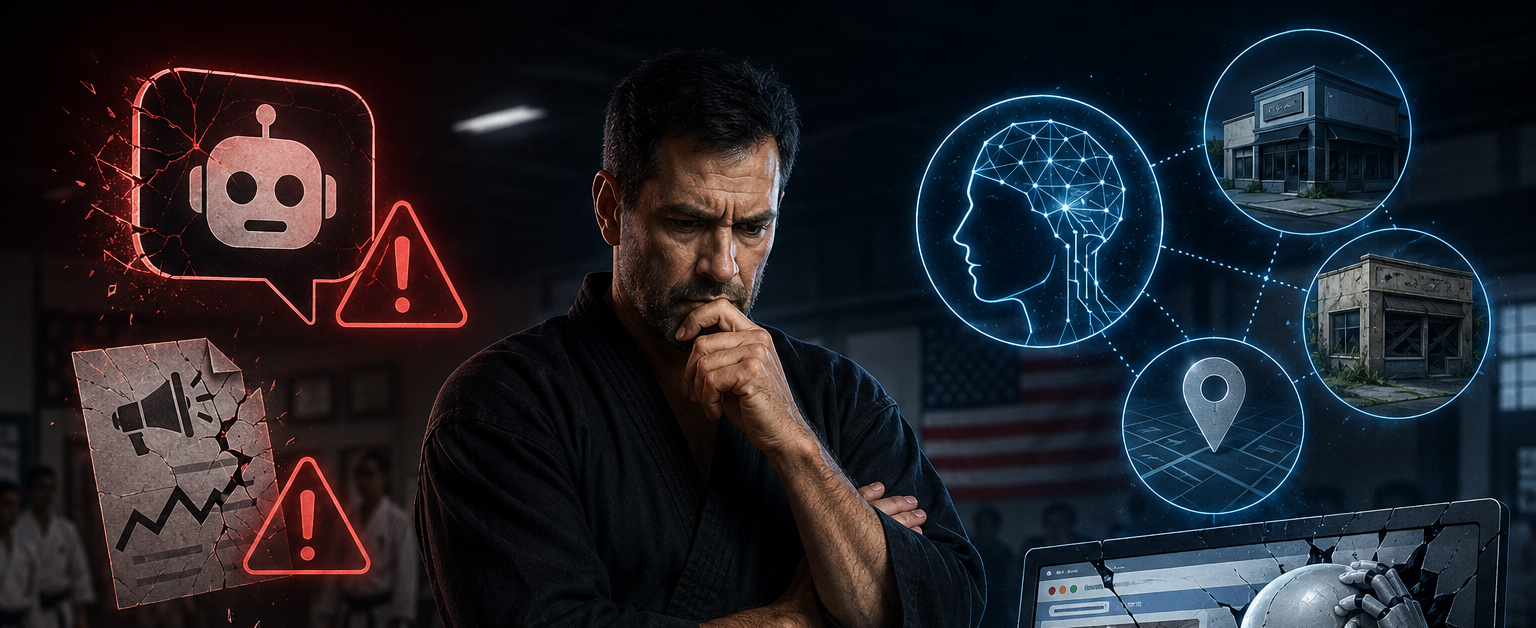
In the last article, we covered how AI strengthens speed, consistency, and operational control. It has some incredible uses! However, now let’s look at where it can quietly damage your school if used carelessly.
The schools that win with AI in the next two years will not be the ones who used it the most. They will be the ones who used it well without breaking something important along the way.
Here are some of the many failures showing up across our industry right now.
The Chatbot That Promised Something You Don’t Offer
Air Canada’s website chatbot told a grieving customer he could get a partial refund under a bereavement-fare policy. The actual policy did not work that way. The British Columbia Civil Resolution Tribunal ruled the airline was responsible for what its AI promised — over $650 plus fees. The precedent is now established: companies own what their chatbots say.
Now picture your website AI confidently telling a parent, “Yes, we offer a 30-day money-back guarantee on Black Belt Club” — when you don’t. Or, “Make-up classes never expire.” Or, “First month is free for siblings.” The parent has the screenshot. You owe what your AI said.
This is not theoretical. Owners are installing chat AI without auditing what it tells prospects after hours. Your contract says one thing. Your AI says another. A judge will side with the parent.
The Marketing Prompt That Made Things Up
Owners are asking AI to write Facebook ads, parent emails, re-enrollment campaigns, and landing pages — and AI cheerfully invents details it has no way of knowing.
A simple ask: “Write a Facebook ad for our after-school program.”
AI returns: “Studies show martial arts students score 23% higher on standardized tests. Our award-winning program serves over 500 families in the Phoenix area…”
The 23% figure does not exist. There is no award. You may have 80 families, not 500. None of this came from you. AI-generated authoritative-sounding fiction because the prompt did not constrain it.
Accuracy rate when NP Digital tested ChatGPT against 600 marketing prompts
Of marketers report seeing AI errors weekly
Admit they have already published hallucinated content publicly
Confidently stated facts in AI marketing output that are wrong
If you ask AI for marketing copy and accept what comes back without verification, you are gambling with your school’s credibility on every post.
The Four Ways AI Fails on Parent-Facing Content
When AI gets it wrong, the failure usually falls into one of four categories.
Fabrication. AI cites a “2024 University of Michigan study” showing martial arts improves ADHD outcomes by 47 percent. The study does not exist. AI manufactured it.
Omission. AI writes a bullying-prevention page that leaves out your actual program — your real curriculum, your real instructor credentials, your real results.
Outdated information. AI describes the program you replaced two years ago, lists pricing from 2022, or references a former location address.
Misclassification. A parent asks about adult kickboxing, AI responds with information about your kids’ Taekwondo program — confidently, fluently, completely off-target.
Every parent-facing email, blog post, ad, and chat response can fail in one of these four ways. Most owners cannot tell which type of error they are looking at because the output reads professionally either way.
The Google Ranking Collapse
Some owners have loaded their websites with 50, 100, even 200 AI-generated blog posts. “10 Benefits of Martial Arts for Kids.” “Why Discipline Matters for Children.” “How Karate Builds Confidence.” Every article is indistinguishable from every other school’s AI dump.
Google’s helpful-content updates now actively penalize exactly this pattern. Schools that cranked out mass AI content in 2024 are watching their rankings collapse in 2026. The site looks busier than ever and ranks worse than ever.
Chief Master Greg Moody, Ph.D.
The Wrong-School Recommendation
A parent in your city opens ChatGPT and asks, “What is the best martial arts school near me for a seven-year-old?”
AI confidently recommends a competitor. Sometimes one that closed two years ago. Sometimes one in a different city. Sometimes a low-quality school with a flashy website and weak instruction.
You never see this happen. The parent never visits your school. You assume your marketing is not working. The real problem is that AI does not know your school exists in any structured, machine-readable way.
This is where AEO — Answer Engine Optimization — separates schools that get recommended from schools that get skipped. If your website is not built with proper schema, structured data, and clear entity relationships, you are invisible to the systems that parents are now asking about.
The Worst: AI Auditing Your Own Website
Here is the failure that ties all of this together.
Owners have started running their own websites through ChatGPT and asking, “Is this good? What should I improve?” The output looks impressive — long, organized, full of specific recommendations. Owners screenshot it, share it in groups, and start making changes based on it.
The output is also almost always wrong.
ChatGPT does not actually see your current website. The model was trained on data with a cutoff date — meaning when you paste your URL, it often answers from training memory rather than fetching the live page. OpenAI’s developer community is full of complaints about exactly this behavior.
Even when AI does fetch your site, it commonly conflates your domain with old cached versions, with directory listings, and sometimes with competitor sites that share keywords.
It cannot test mobile load speed on a real phone. It cannot see whether your form actually submits. It cannot validate your schema. It cannot follow the conversion path on an iPhone. It cannot see logged-in member portals or dynamic content. It cannot tell you what AI Overview actually returns when a parent searches you.
What it can do is generate confident-sounding recommendations that praise features you do not have, flag problems you fixed last year, and reference industry benchmarks that exist nowhere outside the AI’s hallucination.
I have personally watched owners spend weeks rewriting pages based on AI audits — fixing things that were not broken and missing the things that actually were… and having their results tank.
A real audit looks at live page speed, schema validation, conversion tracking, and observed AI Overview behavior. AI cannot do that audit. It can only describe what such an audit might say.
What This Means for You
AI is a tool. Tools are dangerous when the operator does not know the tool’s limits.
Modern Go2 Karate websites and platforms like Rev Connect 360 are engineered with structured schema, real audit infrastructure, and disciplined AI use built in — so the technology accelerates your school instead of quietly damaging it.
Used carelessly, AI will erode your trust, your rankings, and your judgment. It’s not that you can’t use AI, but watch out for the dangers.