On April 6, 2026, at approximately 6:45 in the evening Eastern time, the four astronauts aboard NASA’s Artemis II mission passed behind the far side of the moon. All communication with Mission Control at Johnson Space Center was cut off instantly. For 40 minutes, the most isolated humans in history were completely unreachable. There was no signal. No data. No voice contact. Dead air.
Mission Control did not panic. The crew did not panic. Because the blackout had been planned for, prepared for, and engineered around. Every system on the Orion spacecraft had been designed to operate independently through the blackout. Every crew decision that needed to be made during those 40 minutes had been anticipated and prepared for well in advance. When contact was reestablished at 7:25 p.m., the mission continued without interruption, exactly as designed.
The 40-minute blackout was a known variable. The crew came around the far side of the moon and the signal came back. What greeted them on the other side was extraordinary: Earth rising above the lunar horizon, the same image that had inspired an 8-year-old’s winning design, now witnessed in person for the first time by humans since 1972.
Your martial arts school may be in a blackout right now. The difference is that nobody planned for it, nobody is managing around it, and unlike the Artemis II crew, you may not even know it is happening. Because the blackout I am describing is not a temporary loss of radio contact. It is a structural, ongoing invisibility inside the search systems that are now responsible for how a growing percentage of parents in your city find their next martial arts school.
Two Search Worlds, One Very Different Outcome
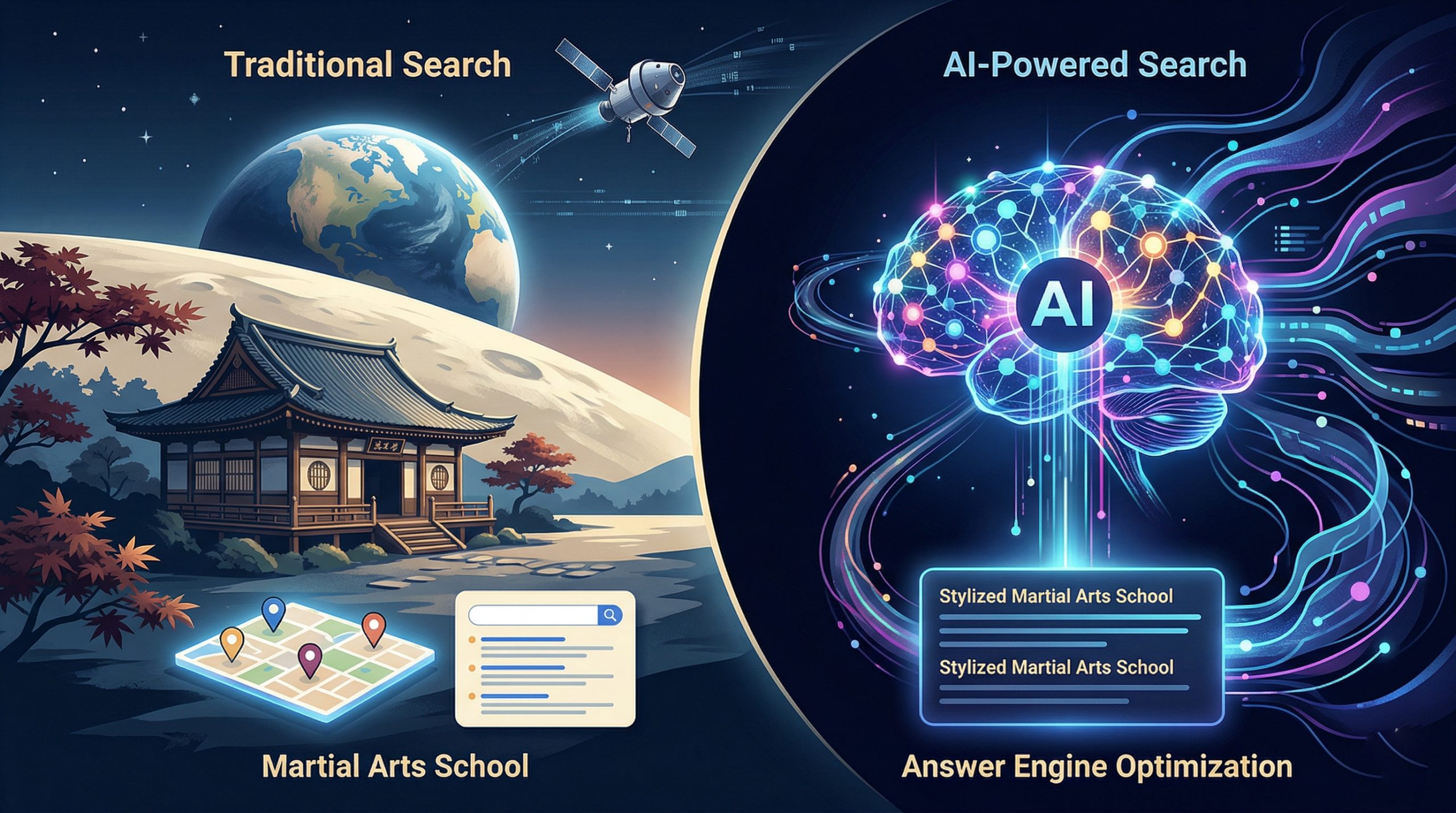
There are now effectively two parallel search environments operating simultaneously, and most martial arts school owners are visible in only one of them.
The first is traditional search. A parent opens Google, types a query, and receives a list of ranked links. Your school may appear in that list. If you have done reasonable SEO work, maintained your Google Business Profile, and accumulated reviews, you probably do appear somewhere in those results. This is the search environment that most school owners have spent the past decade trying to understand and optimize for. It still matters. It is not going away.
The second is AI-powered search. A parent asks Perplexity, ChatGPT, Google’s AI Overview, or a voice assistant for a recommendation. The system does not return a list of links. It generates a synthesized answer, often naming specific businesses it considers credible and relevant, and presents that answer as if a knowledgeable person had been asked the question directly. The parent receives a recommendation, not a list to sift through. And if your school is not in that recommendation, you do not exist for that search. There is no page two. There is no “also consider.” There is the answer, and there is the blackout.
The schools that appear in AI-generated recommendations are not necessarily the largest schools or the oldest schools or the schools with the most expensive websites. They are the schools whose digital presence sends the signals that AI systems recognize as indicators of a trustworthy, relevant, established local entity. Those signals are specific, they are buildable, and they are almost entirely unknown to the average school owner because nobody has explained them in plain language.
“Most school owners assume that because they rank on the first page of Google, they are visible. They have no idea there is an entirely separate search environment growing alongside the one they know, and that their school may be completely absent from it. The blackout is real. It is happening now. And it is affecting inquiry volume in ways that are hard to trace if you do not know what to look for.”
Tracy Lee Thomas | Founder, Rev Marketing & Go2 Karate
How AI Search Actually Works, and Why Most Schools Fail It
To understand why your school might be invisible in AI-generated search, you need to understand what these systems are actually doing when they generate a local recommendation.
AI search systems do not crawl your website the way a traditional search engine does, index your pages, and rank them by keyword relevance. They draw on a much broader and more complex set of signals to determine which businesses are trustworthy, relevant, and worth recommending. The most important of those signals fall into three categories.
Entity Clarity
AI systems need to be able to identify your school as a single, coherent, consistent entity across the web. That means your school’s name, address, phone number, and website URL must appear identically on every platform where your school exists: your Google Business Profile, your Go2 Karate listing, your Facebook page, your Yelp listing, your website, and every directory that references your business. When these signals are inconsistent, the AI system cannot confidently determine that all of these references point to the same real-world business. That uncertainty suppresses your school’s visibility in generated recommendations.
Structured Data
Schema markup is code that tells search engines and AI systems exactly what type of business you are, what services you offer, where you are located, what your hours are, and how to categorize you. It is the language that your website uses to speak directly to machines rather than to humans. Most CRM-based websites and many independently built sites have little or no schema markup. Without it, AI systems have to guess what your website is about rather than being told directly. In a competition where structured clarity is rewarded and ambiguity is penalized, guessing is not a winning strategy.
Authority Signals
AI systems look for evidence that your school is a real, established, trustworthy presence in its community. That evidence comes from the volume and recency of your Google reviews, from citations on authoritative directories like Go2 Karate, from mentions of your school on third-party websites, and from the consistency with which your school’s information appears across the web. A school with 140 recent reviews, a complete Go2 Karate listing, and consistent NAP data across 30 directories sends dramatically stronger authority signals than a school with 18 old reviews, an incomplete directory presence, and inconsistent contact information scattered across the web.
The key distinction: Traditional SEO optimizes for ranked links. AI search optimization ensures your school is recognized as a trustworthy entity. These are related but not identical disciplines, and the gap between them is where most school owners are currently losing ground without knowing it.
The Three Layers of AI Search Your School Needs to Exist In
There is not one AI search environment. There are several, and they operate on overlapping but distinct signals. A school that is well-positioned for all three is dramatically more visible than a school that has addressed only one or none.
Google AI Overviews
Google’s AI Overviews now appear in nearly half of all Google searches. When someone searches for a martial arts school in your city, an AI Overview may appear above the traditional local pack, summarizing the best options and sometimes naming specific schools. Getting into those overviews requires the same entity signals that drive traditional local SEO, but with additional weight placed on structured data, review content quality, and the comprehensiveness of your Google Business Profile. A profile with recent posts, photos across multiple programs, responses to reviews, and accurate complete information is far more likely to be included than a dormant, incomplete profile.
Conversational AI Assistants
When a parent asks ChatGPT, Perplexity, or a voice assistant for a local martial arts school recommendation, those systems draw primarily on the web presence your school has built over time. The Go2 Karate directory listing carries meaningful weight here because Go2 Karate is an authoritative domain in the martial arts category, and AI systems trained on web data recognize it as a trusted source of martial arts school information. A school with a complete, well-maintained Go2 Karate listing is more likely to be surfaced by conversational AI systems than a school whose only digital presence is a website and a thin Google Business Profile.
Answer Engine Features
Featured snippets, knowledge panels, and People Also Ask boxes are all answer engine features that sit at the intersection of traditional SEO and AI-powered search. These features pull structured, clearly organized content from websites and present it directly in search results without requiring a click. Schema markup is the primary driver of eligibility for these features. A website that clearly tells Google what type of business it is, what services it offers, and where it is located is far more likely to be featured in these high-visibility placements than a website that requires Google to guess.
The Scale of the Shift
The move toward AI-powered search is not a future trend. It is a present reality that is accelerating faster than most local business owners have registered.
Drop in clicks to organic search results when a Google AI Overview is present in the results
(Ahrefs, 2026)
Predicted decline in traditional search engine volume by 2026 as AI answer engines grow
(Gartner)
Of all Google searches now trigger an AI Overview above the traditional results
(BrightEdge, 2025)
Duration of the Artemis II communications blackout behind the moon, planned for and managed successfully
(NASA, April 2026)
The Artemis II crew knew the blackout was coming. They prepared for it. They designed every system to operate through it and to reestablish contact the moment they came around the other side. The schools that are preparing now for the AI search environment are doing the same thing. They are designing their digital presence to function in a world where AI-generated recommendations are increasingly how families find the services they need. The schools that are not preparing are not failing because they are lazy or uninformed. They are failing because no one has shown them what the blackout looks like or how to come out of it.
Coming Out of the Blackout
A school we work with in the Mountain West had solid traditional SEO. They ranked on page one for two of their three primary local search terms. Their Google Business Profile was reasonably complete. By every traditional measure, they were performing adequately. But their inquiry volume had been quietly declining for eight months, and they could not identify why.
When we audited their AI search visibility, the picture was clear. Their website had zero schema markup. Their Go2 Karate listing was incomplete and had not been updated in over a year. Their NAP data was inconsistent across 14 of the 22 directories where their school appeared, with two different phone numbers and three different variations of their business name. They were invisible in AI-generated local recommendations despite being visible in traditional search results.
Schema markup elements on their website before the audit
Of 22 directory listings with inconsistent NAP data
Increase in monthly inquiry volume within 90 days of AI search optimization
We implemented a complete LocalBusiness schema package on their website, corrected every NAP inconsistency across all 22 directories, rebuilt their Go2 Karate listing with full program details and current photos, and established a review generation process that produced 44 new reviews in 60 days. We also added structured FAQ content to their website optimized for the specific questions parents ask when searching for martial arts schools, creating eligibility for People Also Ask placements.
Within 90 days, their monthly inquiry volume had increased by 68 percent. The growth came almost entirely from search sources that had previously been generating nothing: AI Overview appearances, conversational AI recommendations when we tested specific local queries, and a featured snippet placement for a high-intent local question. Their traditional search rankings did not decline. Their AI search visibility was simply added on top of what already existed, revealing an entirely new channel of organic inquiries that had been invisible to them because they had not been structured to receive it.
The Blackout Your Competitors Have Not Noticed Yet
Here is the most important thing to understand about where we are in this transition: the majority of your competitors are in the same blackout you may be in right now. Most small and mid-sized martial arts schools have not addressed AI search visibility. They have not implemented schema markup. They have not audited their NAP consistency. They have not optimized their Go2 Karate listing with AI citation in mind. They are operating under the assumption that their traditional SEO is enough, because nobody has shown them that the game has changed.
That is the window. Not a window that will stay open indefinitely. The schools that move now build an AI search presence while their competitors are still unaware that one is needed. The schools that wait will find themselves trying to close a gap that has been widening for months or years, in a competitive environment where the schools that showed up early are already deeply established in the AI systems that families are increasingly relying on.
The Artemis II crew did not come around the far side of the moon unprepared. They had planned for the blackout, engineered around it, and were ready to reestablish contact the moment the signal became available again. The signal is available right now. Your school can come out of the blackout. But it requires knowing that you are in one, understanding what caused it, and taking the deliberate steps to correct it before your competitors do.
“The schools that will dominate local AI search in 2027 are the ones building their presence in 2026. This is not a distant trend to prepare for eventually. It is an active competition happening right now, in your market, with your potential students. The question is not whether AI search matters for your school. The question is whether your school is structured to be found by it.”
Tracy Lee Thomas | Founder, Rev Marketing & Go2 Karate
What Comes Around the Far Side
When the Artemis II crew came around the far side of the moon and reestablished contact with Mission Control, they were greeted with something extraordinary. The Earth rising above the lunar horizon. A view that no human had seen from that angle in more than 50 years. The blackout ended and what was on the other side was worth the preparation.
Coming out of an AI search blackout is not quite so dramatic. But the results are real and measurable. Schools that have corrected their entity signals, implemented structured data, completed their directory presence, and built consistent authority across the web find themselves appearing in recommendations they had never appeared in before. They find inquiry volume increasing from sources they could not previously trace. They find parents calling who say they found the school through a recommendation on their phone, not through a link they clicked.
That is what exists on the other side of the blackout. A channel of high-intent, AI-generated visibility that compounds over time, costs nothing in ongoing ad spend, and rewards the schools that built it correctly with a presence that competitors cannot easily replicate once it is established.
If you are not sure whether your school is in a blackout right now, that is the first question our Strategic Development Team will answer for you. The audit is complimentary, the findings are honest, and the path out of the blackout is clearer than you probably think.
Schedule your complimentary Strategic Development call at Go2Karate.com. [INSERT BOOKING LINK]
Sources & Citations
- NASA – Artemis II Lunar Flyby and Communications Blackout: Mission timeline, April 6 2026 (nasa.gov)
- Ahrefs – AI Overviews and Click-Through Rate Impact on Organic Results, 2026 (ahrefs.com)
- Gartner – Prediction: 25% Drop in Traditional Search Engine Volume by 2026 (gartner.com, via writer.com)
- BrightEdge – AI Overviews Frequency Study: Percentage of Google Searches Triggering AI Overviews, 2025 (brightedge.com)
- Google Search Central – Schema Markup and Structured Data Documentation for Local Businesses (developers.google.com/search)
- Moz – Local SEO: NAP Consistency as a Ranking and Entity Authority Signal (moz.com)
- SparkToro / Datos – Zero-Click Search and AI-Generated Answer Trends, 2024-2025 (sparktoro.com)
- EMARKETER – GEO and AEO: How AI Search and SEO Overlap for Local Businesses in 2026 (emarketer.com)
- Google – E-E-A-T Framework and Its Application to Local Business Authority Signals (developers.google.com/search)