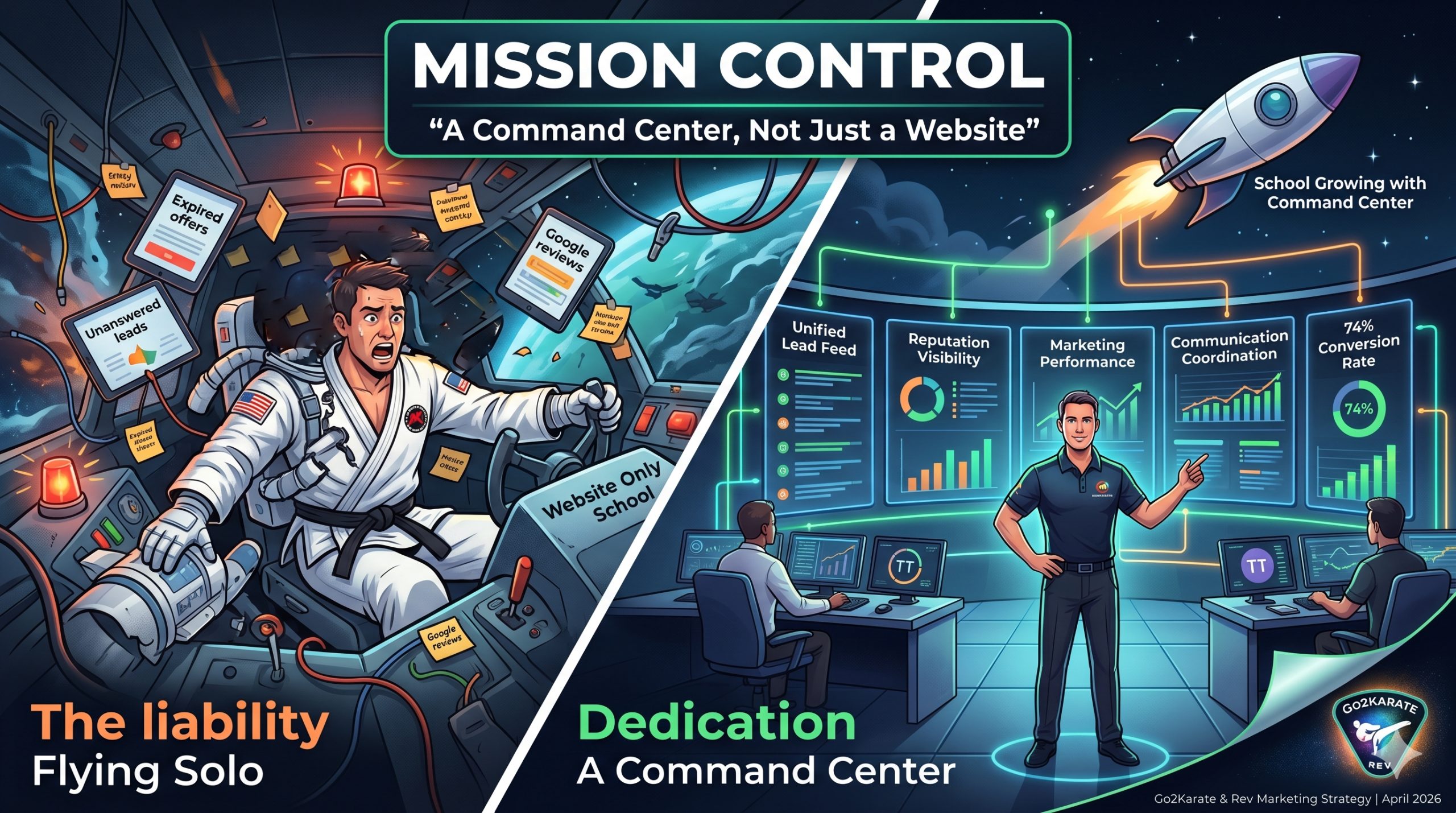
At Johnson Space Center in Houston, Texas, hundreds of flight controllers, engineers, and support specialists filled the Mission Control room during the Artemis II lunar flyby. Each person had a specific console. Each console monitored a specific system. Flight dynamics. Power. Communications. Propulsion. Life support. Guidance. Each station fed data into a unified picture that allowed the Flight Director to see the entire mission in real time and make decisions with confidence.
Not one of those specialists was also flying the spacecraft. Not one of them was simultaneously teaching a class, answering the front desk phone, managing a Facebook page, responding to Google reviews, chasing down a lead from three days ago, updating a class schedule, and trying to figure out why inquiries have been slow this month. The crew flew. Mission Control coordinated everything else. The mission succeeded because the two functions were separated, specialized, and connected through a unified system that gave every person exactly the information they needed to do their job.
Now consider the average martial arts school owner on a Tuesday afternoon. They are teaching the 4:30 kids class. Their phone is ringing in the office with a parent inquiry they will not hear until 6:15. Their last Google review, which came in this morning, is sitting unanswered. Their Facebook ad, which a freelancer set up three months ago, is sending traffic to a landing page with an expired offer. Their CRM has 14 leads marked as “follow up” that have not been touched in a week. And somewhere in a browser tab they have not opened in two days, their website analytics are showing a traffic drop that nobody has noticed yet.
That is not a failing school. That is an extraordinarily common school being run by an extraordinarily capable person who is attempting to be both the astronaut and Mission Control simultaneously. It does not work for NASA. It does not work for martial arts schools either.
The Tool Accumulation Trap
The marketing technology industry has spent the last decade selling school owners on the idea that the right tool will solve the problem. Need more reviews? There is an app for that. Need to manage leads? There is a CRM for that. Need to run ads? There is a platform for that. Need to post on social media? There is a scheduler for that. Need to send email campaigns? There is a service for that. Need to track calls? There is a number for that.
The result, for most school owners who have followed this path, is a fragmented stack of five to eight tools that do not communicate with each other, each generating its own reports in its own format, each requiring its own login and its own learning curve, and collectively costing more per month than an integrated solution would while delivering a fraction of the value. The school owner is paying for the illusion of infrastructure while actually operating without one.
The average small business in the United States now uses between eight and twelve separate software tools to manage its operations. Research consistently shows that the more fragmented a company’s technology stack, the less visibility leadership has into actual performance, the more time is spent on administration rather than growth, and the higher the rate of leads and opportunities lost in the gaps between systems that were never designed to work together.
“I have audited schools that are paying for a review platform, a texting service, a separate email tool, a social media scheduler, and a basic CRM, none of which talk to each other, and spending more combined than a fully integrated platform would cost. They have five dashboards and zero visibility. They have more tools than Mission Control and less information than a clipboard.”
Tracy Lee Thomas | Founder, Rev Marketing & Go2 Karate
What a Command Center Actually Does
Mission Control at Johnson Space Center is not impressive because it has a lot of screens. It is impressive because every screen shows data from a unified system, and because every person reading those screens is working from the same picture of reality. There is no version of the mission in the flight dynamics room that contradicts the version in the propulsion room. Every station sees the same spacecraft, the same mission, the same moment in time. That shared clarity is what allows complex decisions to be made quickly and correctly under pressure.
A marketing command center for a martial arts school works on exactly the same principle. It is not about having more tools. It is about having one unified view of your school’s growth engine: where leads are coming from, what is happening to them after they arrive, how your reputation looks to the parents researching you right now, what your digital presence looks like across every platform, and what your conversion numbers actually are. That unified view is the difference between flying blind and flying with Mission Control behind you.
Lead Intelligence
A command center shows you every inquiry the moment it arrives, regardless of which channel it came from. A parent who finds you through Go2 Karate, a parent who calls from a Google search, a parent who submits a form on your website, and a parent who sends a Facebook message are all visible in one place, in real time, with the same information available about each of them. No lead falls through a gap between platforms. No follow-up relies on a sticky note or a memory. Every inquiry enters a managed sequence the moment it is received.
Reputation Visibility
A command center shows you every new review across every platform the moment it appears, and flags the ones that need a response. It shows you your average rating trend over time, your review volume compared to last month and last year, and the sentiment patterns in what parents are saying about your school. Instead of checking Google and Yelp and Facebook separately once a week and hoping you have not missed anything, you see your entire reputation in a single view that updates in real time.
Marketing Performance
A command center shows you which channels are actually producing enrollments, not just leads. It connects the source of an inquiry to the outcome of that inquiry so you know whether the 40 leads your Facebook ad produced last month turned into 4 enrollments or 14. Without that connection, you are making budget decisions based on lead volume rather than enrollment return, which is one of the most expensive mistakes a growing school can make.
Communication Coordination
A command center handles the outbound communication that most school owners are either doing manually and inconsistently or not doing at all. The text that goes out within 90 seconds of a new inquiry. The follow-up call reminder 2 hours later. The trial class confirmation email. The 48-hour reminder text. The post-trial follow-up. These sequences run automatically, consistently, and correctly every time, regardless of whether the owner is on the mat, in a meeting, or asleep. The mission continues even when the pilot is unavailable.
The Hidden Cost of Flying Solo
Most school owners significantly underestimate what operating without a command center actually costs them. The cost is not just the monthly fees for disconnected tools that do not work together. It is the revenue that never materializes because the infrastructure to capture and convert it does not exist.
Research on lead response time is unambiguous and has been replicated across dozens of studies in multiple industries. The probability of converting a lead drops dramatically within the first five minutes of non-response. A parent who inquires about your school at 7:15 on a Tuesday evening, when you are running your adult class, and receives no response until Wednesday morning has an almost entirely different likelihood of enrolling than a parent who receives a warm, personal text response within 90 seconds of their inquiry. The quality of the lead did not change. The quality of the response did. And that difference, multiplied across every inquiry your school receives in a year, is where the command center either earns its cost or proves its absence.
The math most owners never run: If your school receives 30 inquiries per month and converts 20 percent of them, that is 6 new students. If an integrated command center with automated follow-up raises your conversion rate to 74 percent, that is 22 new students from the same lead volume. Multiply the difference by your monthly tuition rate and your average student lifetime of three to five years. That number is what operating without a command center is costing you every single month. For most schools, it is the largest untracked expense in the business.
What the Data Says About Integrated Operations
Less likely a lead is to convert if the first response arrives after 30 minutes vs. within 5 minutes
(InsideSales.com / HBR)
Average number of separate software tools used by small businesses, most of which do not share data
(Blissfully Annual SaaS Report)
Of small business owners say managing multiple disconnected platforms is one of their top three operational challenges
(Salesforce SMB Report, 2024)
Specialists staffing NASA Mission Control during the Artemis II lunar flyby, each focused on one system so the crew could focus on the mission
(NASA, 2026)
The parallel to Mission Control is not decorative. The Artemis II crew of four was supported by hundreds of specialists on the ground, each owning a specific system so the crew could concentrate entirely on flying. The school owner who is also managing their own CRM, their own review responses, their own lead follow-up, their own ad campaigns, and their own directory listings is not operating with Mission Control behind them. They are trying to be the crew and Mission Control simultaneously, and the mission is suffering for it.
When the Ground Team Takes Over
A school owner in the Mid-Atlantic region came to us paying for five separate tools: a review request platform at $49 per month, a texting service at $79 per month, an email marketing tool at $39 per month, a basic CRM at $89 per month, and a social media scheduler at $29 per month. Total monthly spend on tools alone: $285. None of the five tools shared data with any other. The owner spent an estimated six to eight hours per week moving information between platforms manually, following up on leads from a spreadsheet, and checking five separate dashboards to understand what was happening in their business.
Their lead-to-enrollment conversion rate was 14 percent. Their average response time to new inquiries was 4.2 hours, based on the data we were able to reconstruct. Their Google review response rate was 31 percent, meaning more than two thirds of their reviews, positive and negative, were going unanswered.
Average lead response time before command center integration
Lead-to-enrollment conversion rate with fragmented tool stack
Conversion rate within 60 days of unified command center launch
After consolidating to Rev Connect 360, a single unified platform that handled lead capture, automated follow-up sequences, reputation management, CRM, email, and SMS from one dashboard, the owner’s response time to new inquiries dropped to under two minutes. Every review received a response within 24 hours. Every new lead entered an automated sequence that delivered a personal text within 90 seconds, a follow-up call reminder within two hours, and a structured nurture sequence through trial and enrollment.
Within 60 days, their conversion rate had climbed from 14 percent to 74 percent from the same monthly lead volume. The owner recovered approximately six hours per week that had previously been spent managing disconnected tools. Their monthly tool spend dropped from $285 to a single platform investment that included everything the five tools had provided and significantly more. And for the first time, they had a single dashboard that showed them, in real time, exactly what was happening in every part of their growth operation. Mission Control was finally on the ground. The owner could fly.
What Your Command Center Should Show You
If you opened a true marketing command center for your school right now, here is what you should be able to see without clicking through five different logins or building a spreadsheet to connect the data yourself.
You should see every inquiry that arrived today, where it came from, whether it has been contacted, and what the next scheduled touchpoint is. You should see your current Google rating, how many reviews you have received this month versus last month, and which reviews are waiting for a response. You should see which of your active lead sequences are performing and which ones are stalling. You should see your enrollment conversion rate for the current month and how it compares to the previous 90 days. You should see your Go2 Karate listing status and whether your directory presence is current and complete.
If any of those things require you to open a separate tool, log into a separate platform, or build a manual report, you do not have a command center. You have a collection of instruments with no flight director reading them. The mission is still flying. But nobody is watching all the systems at once.
“NASA would never launch a crew to the moon with five separate, disconnected communication systems that the astronauts had to monitor individually while also flying the spacecraft. That is not how missions succeed. It is also not how schools grow. The command center is not a luxury. It is the infrastructure that makes everything else possible.”
Tracy Lee Thomas | Founder, Rev Marketing & Go2 Karate
Houston, Your School Is Ready for Liftoff
The four astronauts aboard Artemis II did not become less capable because they had Mission Control supporting them. They became more capable. They could focus entirely on the mission in front of them because they knew that every system behind them was being monitored, managed, and optimized by people whose entire job was to make sure nothing fell through the cracks.
That is what a unified command center does for a school owner. It does not replace your expertise, your relationships, or your ability to teach. It handles the infrastructure that currently pulls you away from those things. It makes sure that every lead is followed up, every review is addressed, every inquiry is captured, and every conversion opportunity is managed, whether you are on the mat, in a meeting, or picking up your kids from school.
The schools growing most consistently right now are not the ones with the most tools. They are the ones with the clearest picture of what is happening in their business and the systems to act on that picture without the owner having to manage every piece manually. They have a command center. And their owners are finally doing what they do best: teaching, leading, and building the school they set out to build.
If you are ready to find out what a unified command center would look like for your school, our Strategic Development Team is the right starting point. The conversation is complimentary. The clarity it produces is immediate.
Schedule your complimentary Strategic Development call at Go2Karate.com. [INSERT BOOKING LINK]
Sources & Citations
- InsideSales.com / Harvard Business Review – Lead Response Time and Conversion Probability: the 5-minute rule and 21x drop-off after 30 minutes (hbr.org)
- Blissfully Annual SaaS Trends Report – Average Number of Software Tools Used by Small Businesses (blissfully.com)
- Salesforce – Small and Medium Business Trends Report 2024: Operational challenges of disconnected platforms (salesforce.com)
- NASA – Artemis II Mission Control Staffing and Johnson Space Center Operations, April 2026 (nasa.gov)
- NASA – Artemis II Crew and Mission Overview: Reid Wiseman, Victor Glover, Christina Koch, Jeremy Hansen (nasa.gov)
- HubSpot – The State of Marketing 2024: Integrated platform performance vs. fragmented tool stacks (hubspot.com)
- SimpleTexting – SMS Response Rates for Business Lead Follow-Up: Open rates and response time benchmarks (simpletexting.com)
- BrightLocal – Review Response Rate Impact on Consumer Trust and Google Ranking Signals (brightlocal.com)