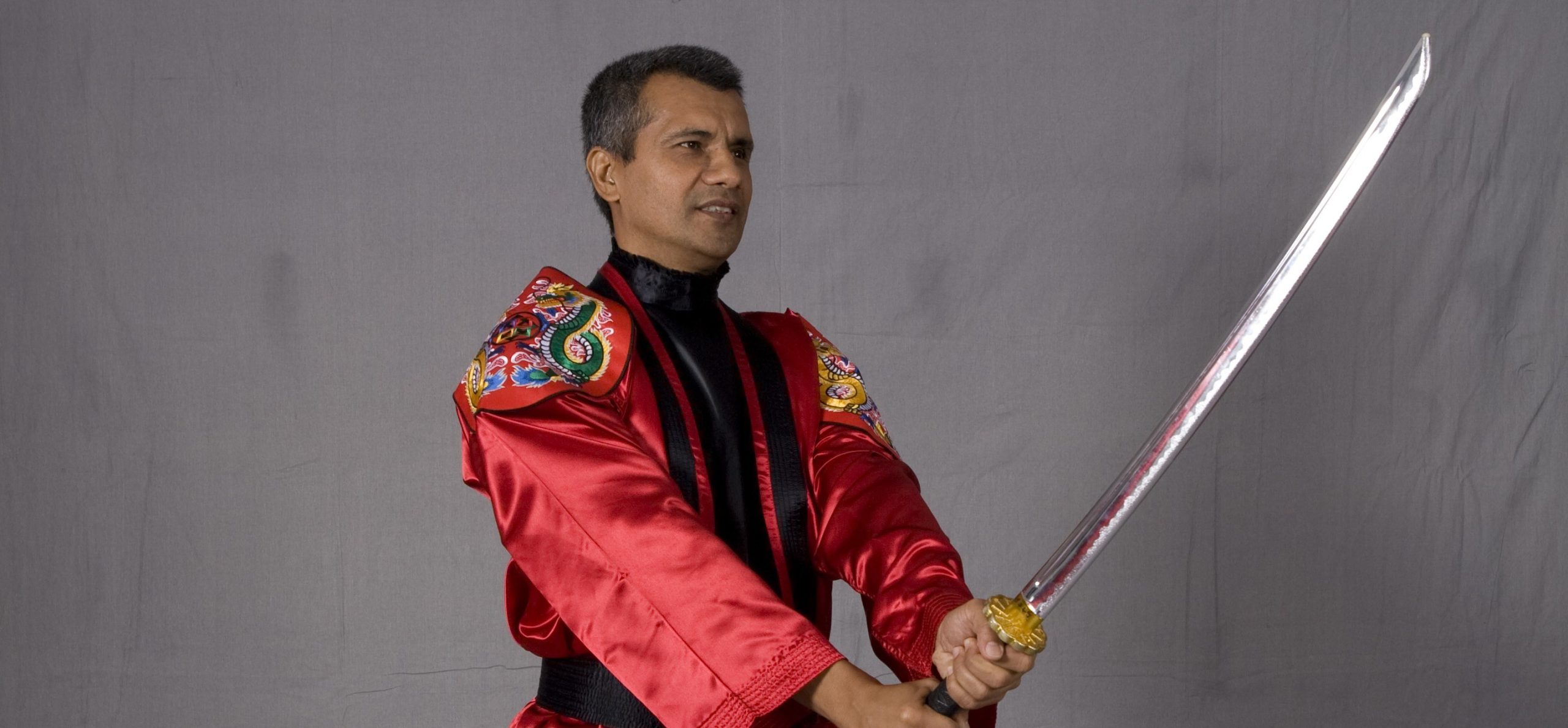
Technical, Conceptual, and Contextual Differences for the Teaching of Gumdo
The study of the Korean sword requires, from the outset, a clear differentiation from the Japanese katana. This is not because one tradition is superior to the other, but because each respond to distinct martial worldviews, shaped by different historical, political, and military contexts. When these differences are not made explicit, there is a risk of interpreting the Korean sword through frameworks that are foreign to it, particularly those derived from the Japanese culture of the duel.
In the Korean tradition, the sword did not develop as a symbol of the individual warrior nor as an object of personal exaltation. Its evolution was closely linked to the state, territorial defense, and a conception of combat oriented toward the battlefield, collective action, and functionality over individual technical display. This logic underlies both historical Korean swords and the principles preserved today in Gumdo.
Geom, Do, and Gumdo: Terminological Framework
From a historical and terminological perspective, Korean sources distinguish between Geom (劍), Do (刀), and Do (道).
Geom (劍) is reserved for straight, double-edged swords, generally associated with ceremonial, ritual, or symbolic functions rather than large-scale combat.
Do (刀) technically designates single-edged weapons, that is, swords with one cutting edge. The vast majority of bladed weapons historically used by the Korean military belonged to this category. Historically, most weapons employed by the Korean army were of the Do type, which is consistent with the fact that contemporary Gumdo practice predominantly uses curved, single-edged blades.
Do (道) means “path” or “way” and is the same character found in disciplines such as Taekwondo or Gumdo. In this sense, Gumdo is not merely “sword handling,” but a martial way—that is, a systematic practice oriented toward the holistic formation of the practitioner.
The term Gumdo (검도 / 劍道) therefore does not describe the exact morphology of the weapon, but rather the martial path of the sword. Here, geom functions as a broad term referring to the martial field of the sword in general, while do (道) expresses the idea of path, discipline, and integral training. Consequently, there is no contradiction between training with a Do-type sword and practicing Gumdo, provided that the distinction between technical classification and martial denomination is properly understood.
The Korean Sword and the Katana: Two Conceptions of Combat
The Japanese katana developed within a feudal society dominated by a hereditary warrior class, in which individual combat and dueling occupied a central place. Although the katana was used in military campaigns, its technical refinement was deeply influenced by the logic of one-on-one confrontation, rapid resolution of combat, and the symbolic importance of the individual gesture.
The Korean sword, by contrast, was conceived within a radically different context. During the Joseon dynasty, the use of weapons was regulated by the state and systematized in official military manuals. In these texts, the sword appears as a functional tool integrated into a broader tactical system, rather than as an extension of the individual combatant’s identity.
This difference in origin explains why the Korean sword was not designed for dueling, but for the battlefield, understood as a collective, unpredictable, and constantly changing environment.
General Technical Differences
From a technical standpoint, the katana and the Korean sword respond to different needs.
The katana prioritizes:
- Extreme precision of the cut
- Economy of movement
- Control of the center in frontal confrontation
- Rapid resolution through one or a few decisive exchanges
The Korean sword, by contrast, prioritizes:
- Continuity of movement
- Broad, functional displacement
- Constant adaptation to multiple threats
- Physical endurance and the ability to sustain action over time
In the Korean sword tradition, combat is not conceived as a single perfect instant, but as a process that must remain under control even under adverse conditions.
A Key Structural Difference: Drawing the Sword
One of the most important and least explained contrasts between the katana and the Korean sword lies in the manner of drawing the sword, as this action clearly reveals the martial logic of each tradition.
In the Japanese tradition, drawing the sword becomes a central technical act, highly ritualized and charged with meaning. Drawing is not merely a transition, but an active part of the attack, and in many cases the outcome of combat is decided in that initial moment.
In the Korean sword tradition, the approach is different. Historically, the sword was carried in a more functional manner, with attachment systems designed for movement during campaigns and coexistence with other weapons. Drawing the sword does not occupy a central or ritualized place, since combat does not presuppose a formal confrontation or a clearly defined beginning. The sword may be drawn before direct contact, and technique unfolds once the weapon is already in use, not in the initial instant.
In modern Gumdo, this translates into less emphasis on drawing as a decisive gesture and greater emphasis on:
- Posture
- Control of the body’s axis
- Fluid transitions between positions
- Technical continuity once movement has begun
Types of Korean Swords: Functional Diversity
The conception of the sword as a tool of organized warfare gave rise to significant typological diversity, in which each weapon responded to a specific function.
The Hwando (환도) was the most common sword of the Joseon period. Single-edged and generally slightly curved, it was worn at the waist using rings attached to the scabbard. Its function was practical and regulatory, used by soldiers, officers, and guards.
The Ssangsudo (쌍수도) a long two-handed sword, was intended for specific battlefield roles such as maintaining distance or confronting formations. Its existence demonstrates that the Korean sword tradition was not limited to a single model, but adapted to diverse tactical needs.
The Yedo (예도) is a short, single-edged sword historically used as a secondary weapon in military contexts. Its function was strictly practical: responding to close-range combat, confined spaces, or situations in which the primary sword was impractical. Unlike Japanese short swords, the Yedo does not carry ritual or symbolic significance, but reflects the pragmatic logic of Korean armament, where effectiveness and adaptability to the battlefield take precedence over individual warrior identity.
The Bonguk-geom (본국검) literally “national sword,” designates a set of practices and weapons that express a distinct Korean martial identity, differentiated from external influences. Although its name includes the term geom, it is historically associated primarily with the use of single-edged swords integrated into the technical and military system of the state. Rather than referring to a single standardized weapon, Bonguk-geom represents a conceptual and technical framework that affirms the autonomy and internal coherence of the Korean sword tradition.
The Woldo (월도) a pole weapon with a curved blade, combined military and symbolic functions. Its size and presence associate it with spatial control and with figures of high rank.
Gumdo as Martial Continuity
Modern Gumdo does not seek to literally reproduce historical combat, but it does preserve fundamental structural principles of the Korean sword tradition: stability, bodily control, continuity of movement, and technical discipline. The sword remains a means of formation, not an object of personal exaltation.
Understanding these foundations makes it possible to practice and teach Gumdo without confusing it with the logic of the Japanese katana, even when both traditions employ curved blades. The primary difference does not lie in the external shape of the weapon, but in what it was conceived for and how it is understood martially.
Two Distinct Responses
The katana and the Korean sword represent two distinct responses to different historical challenges. The former developed as the weapon of the individual warrior and the duel, the Korean sword as a tool of the state and the battlefield. Gumdo, inheriting this tradition, preserves a functional and collective martial ethic, in which the sword does not symbolize the individual, but the path of discipline that the practitioner follows.