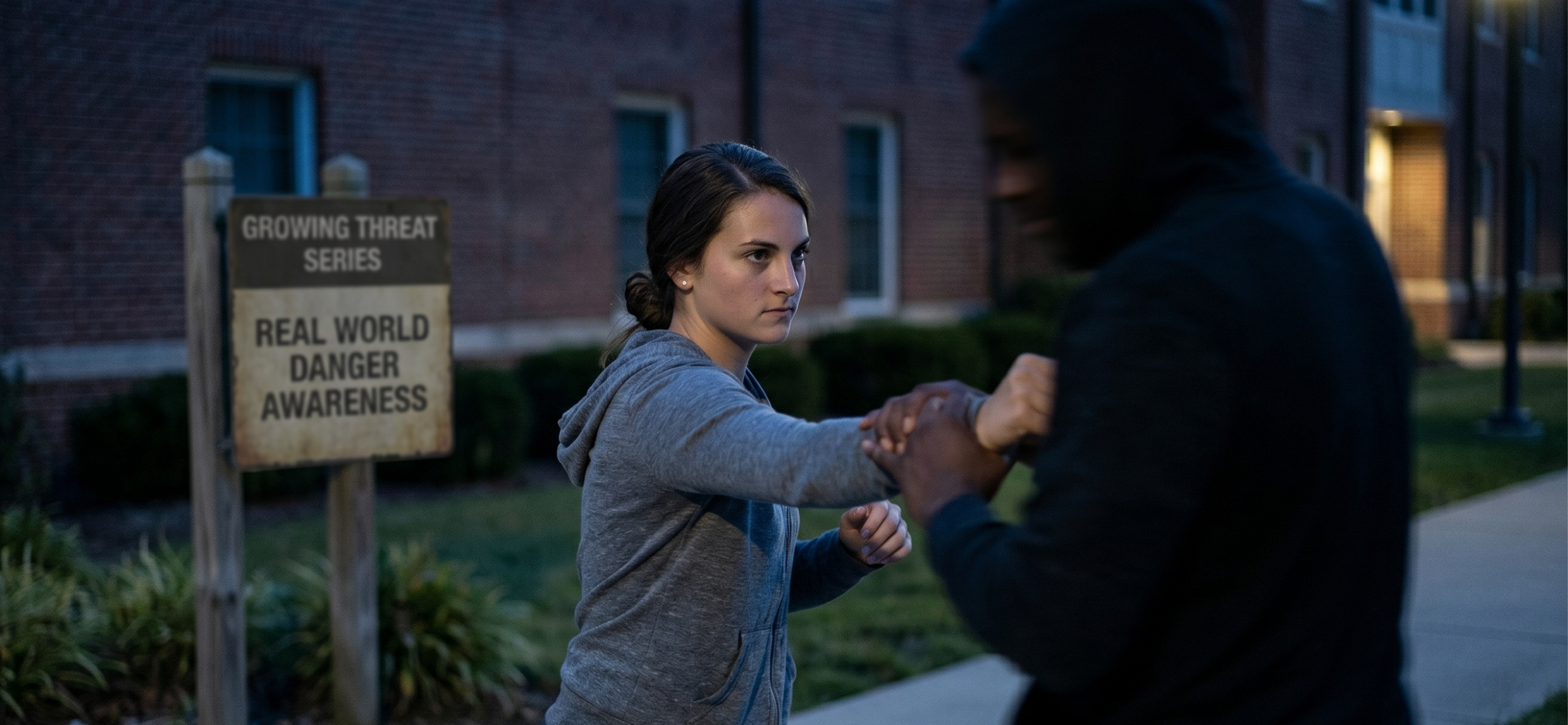
Move-in day is one of the proudest moments a parent ever lives through. The boxes come out of the car, the dorm room takes shape, and a son or daughter who used to ask permission to ride a bike across town suddenly has a key to their own front door. It is exciting. It is also, statistically, the most dangerous window of their entire college experience.
That is not opinion. That is a pattern researchers, campus safety officials, and federal data sets have documented for decades. The freedom is real. The risk that comes with it is real. The good news is that readiness is not a personality trait or a matter of luck. It is a skill, and like every real skill, it can be taught in a clear framework that holds up when the heart rate is high and the clock is short.
This article exists to give you that framework. It is the same one I built in my book Real World Danger Awareness, and it is called the G.E.A.R. Method. Before we get to it, every parent needs to see the numbers, because most never do.
The Numbers Most Families Never Hear
U.S. colleges and universities are required by federal law to publish their crime data every single year. That law is called the Clery Act, and it exists because Congress recognized that families were sending their children to schools without an honest picture of what could happen there. The reports are public. Most parents have never read one.
According to the U.S. Department of Education’s Office of Postsecondary Education, more than 22,000 criminal incidents were reported on U.S. college campuses in a single recent reporting year. Motor vehicle theft is now the most common reported campus crime, accounting for roughly 37 percent of all incidents. Burglary, aggravated assault, robbery, and sexual offenses make up most of the rest. Those are only the incidents that get reported. Researchers consistently estimate the real numbers are higher, because students often do not know how to report, who to report to, or whether anything will happen if they do.
Inside that picture is a smaller window that deserves a parent’s full attention. Campus safety researchers call it the Red Zone.
Criminal incidents reported on U.S. college campuses in a single recent reporting year
Of all reported campus incidents that are motor vehicle theft
Sexual assaults reported against first-year students in just September and October at nine studied universities
More likely freshmen are to be assaulted than upperclassmen
The Red Zone: The First Six Weeks of Freshman Year
The Red Zone is the stretch from move-in day through roughly Thanksgiving break. During this period, more than half of all campus sexual assaults reported in a given academic year are estimated to occur. A U.S. Department of Justice study of nine universities found that in just September and October of one school year, 629 sexual assaults were reported against first-year students. That was more than the next four months combined. Freshmen are roughly two and a half times more likely to be assaulted than upperclassmen.
Why? Because they are new. They have not built a circle of trusted friends. They do not know which parties to leave early, which routes home are well lit, which doors lock and which do not. They are eager to belong, which is healthy, and which also makes them visible to anyone looking for someone unfamiliar with the territory. Predators read these signals quickly because the Red Zone is a short window for them as well.
This is not a reason to keep a young adult home. It is a reason to send them with a method.
Tracy Lee Thomas
The G.E.A.R. Method: A Framework That Holds Up Under Stress
In Real World Danger Awareness, I introduced the G.E.A.R. Method as a universal, simple, and effective framework designed to function in real environments under real pressure. It was built for exactly the kind of places college students walk into every single week. Four letters. Four layers. In order.
G is for Guard
Guard is the foundation of the entire system. It is situational awareness in action, and that one phrase covers more ground than most people realize. Situational awareness is the disciplined habit of knowing where you are, who is around you, what is normal for that environment, and what just changed. It is early recognition, trusting instincts, and scanning for what professionals call pre-incident indicators. The student walking back from the library who notices the same person has now passed them twice. The freshman at the party whose drink has been out of their sight for thirty seconds. The gut feeling that says the friendly stranger offering a ride is asking too many questions. The footsteps that have been matching pace for half a block.
Guard is the layer that lets a student see danger forming before it arrives, and it is the layer most college students have never been taught. Schools teach them calculus and creative writing and how to balance a budget. Very few teach them how to notice when a situation has shifted. Situational awareness is not paranoia. It is not walking around expecting the worst. It is simply keeping the head up, the phone down, and the eyes open. Guard is what gives a student multiple seconds of a head start, and in most incidents, seconds is the difference between a near miss and a story they wish they did not have to tell.
E is for Evacuate
Evacuate is decisive movement toward safety and leaving uncomfortable situations immediately. No apology. No explanation. No staying ten more minutes to be polite. The student who has practiced Evacuate does not negotiate with their own discomfort. When something is wrong, they leave.
This sounds obvious. It is not. Most assaults that happen on campus could have been prevented at the Evacuate stage. The student felt something was off and stayed anyway. They did not want to seem rude. They did not want to abandon a friend. They did not want to make a scene. The Evacuate layer gives them permission to do all three. They text their roommate the code word. They call the campus safety escort. They walk into the lit storefront across the street. They get out. The freshman who has internalized Evacuate has already rehearsed leaving, and that rehearsal is what makes it possible when it matters.
A is for Avoid
Avoid is using distance, obstacles, and strategic positioning to limit an attacker’s access. It is the layer that activates when leaving the building is not possible right that second.
Avoid is choosing the seat closer to the door, not the one in the back corner. It is walking the long way around the parking garage to stay near the lights. It is keeping the kitchen island between them and a person whose behavior just shifted. It is sitting where they can see who enters the coffee shop, not where their back is turned to the room. Avoid says that even when the situation cannot be escaped in the next ten seconds, the student can still control space, distance, and what stands between them and a threat. Avoid buys minutes. Minutes are the currency that lets Guard or Evacuate work.
R is for Resist
Resist is the final layer. Physical action, used only as a last resort when escape is blocked and harm is imminent. This is where martial arts training matters most, and where it matters least, all at the same time.
Most, because the student who has trained has options when conversation runs out. They have struck a pad with full intent. They have practiced breaking a grip. They have created distance from a person who outweighs them. They know what their body can do under pressure because they have asked it to perform under pressure before.
Least, because a well-trained student spent so much time at the first three layers that they rarely arrive at Resist. Guard told them to leave, because of the high level of situational awareness. Evacuate got them out. Avoid kept distance between them and the threat. Resist is the fire extinguisher behind the glass: never the goal, always within reach.
The Power Is in the Order
The student who has it is the student who almost never needs it. But when they do need it, nothing else will do besides real world self defense.
The four letters are not equal. They are sequential. Guard before Evacuate. Evacuate before Avoid. Avoid before Resist. By the time a situation has reached the fourth letter, every earlier letter has been tried. Most predators count on victims having no system at all. The student with G.E.A.R. has four, and they have practiced moving from one to the next without freezing in between.
Where G.E.A.R. Gets Built
You cannot download G.E.A.R. the week before move-in. You cannot watch a YouTube video on it and walk into a dorm with it installed. G.E.A.R. is built the way every real skill is built: in repetitions, with feedback, in an environment that takes it seriously. There is exactly one kind of place in most communities where that work gets done consistently, week after week, by professionals whose entire career is built on producing capable, calm, prepared human beings. A quality martial arts school.
A good Martial Arts Instructor is teaching Guard every time a student is asked to scan the room. Evacuate every time they drill exit identification. Avoid every time they practice creating distance and reading a partner’s intent. Resist every time they train a technique against resistance. The student who has trained for a year before college does not walk onto campus with a brown belt. They walk on with a different operating system. They make eye contact. They walk like they know where they are going. They notice the man in the corner of the parking lot before their friends do.
Tracy Lee Thomas
Predators look for the opposite of all of that. They look for the student staring at their phone, the student with no situational awareness, the student who would rather be uncomfortable than impolite. The student with G.E.A.R. fails every test a predator runs in the first five seconds of looking at them. That is not a coincidence. That is what training builds.
Not every martial arts school teaches this material the same way, and parents should be selective. When you walk into a school, ask the instructor directly: do you teach situational awareness and a real safety framework, or only physical technique? Ask whether they teach the G.E.A.R. Method or a comparable system that addresses awareness, evacuation, avoidance, and physical response in that order. A school that takes this seriously will be eager to answer that question. A school that does not will change the subject. That answer alone will tell you everything you need to know about whether this is the right place to send your college-bound student.
A Conversation Worth Having Before Move-In Day
Before the car is loaded, sit down with your student and walk through G.E.A.R. out loud. Use these questions.
Evacuate: Is the campus safety escort number saved in your phone right now? Who are the two people you call first if you need to get out of somewhere? Do those two people know they are on the list?
Avoid: What is your plan if a friend disappears at a party? Where do you sit in a room full of strangers? Where do you walk at night, and where do you refuse to walk?
Resist: What does the word “no” sound like when it actually has to be said out loud? Have you ever said it that way to a stranger?
If any of those answers come back as a shrug, the readiness work is not finished yet. That is not a failure. That is information, and information is the beginning of every good plan.
Understanding…
College is one of the most formative chapters of a young person’s life, and it should be entered with excitement, not fear. Excitement and preparation are not opposites. They live together comfortably in the same student, and the parents who understand that send a different kind of freshman to campus.
Tracy Lee Thomas
If there is a young person in your home heading off to college in the next twelve months, do the academic prep, do the financial prep, do the dorm shopping. And before any of that, walk into a martial arts school and watch a class. Ask whether they teach G.E.A.R. or a comparable framework. The instructor at the front of that room may be teaching it whether they call it by that name or not, but the parents who walk in and ask the question will be the ones who find the right place. Together, the two of you can send a student to campus who is ready for everything college offers, including the parts the brochure does not mention.
They will move in. The question is whether they are ready.